Down Syndrome Research Forum, Mar 2026: Relationships and Respect, not Resilience; An 'Inclusive Education Passport' to a better future
Relationships and Respect, Not Resilience
The closing reflection in my Down Syndrome Research Forum 2026 series.
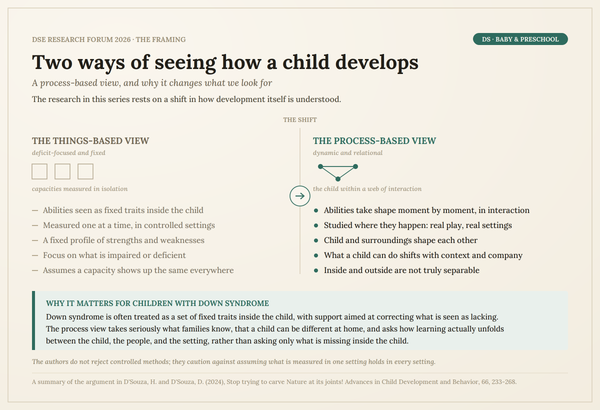
If you read across the years of this Forum, and I have spent a long time doing exactly that, you can watch the story we tell about our children change. The early years were largely about deficit, about what children with Down syndrome could not yet do, measured against everyone else. Slowly the frame turned, toward strengths, toward development understood as something that happens in relationship and in environment rather than inside the child alone, and, more recently, toward the voices of families and of people with Down syndrome themselves. That is a genuine and hard-won shift.
This series has tried to carry some of that out of the conference room. I want to close it by holding three of this year's talks together, because two of them show how much warmth and insight the conversation now holds, and the third forces a reckoning the others politely leave alone.
A word on where I am standing. This piece is about the evidence, not about anecdotes traded on social media, and not about my own experience. If I offered you a personally positive story, I would be downplaying what the research shows; if I offered a negative one, I would be sensationalising it. Neither would be honest to the data. What the evidence describes is not a collection of individual misfortunes. It is a pattern, and that pattern is part of the structural and societal inequalities that individuals with Down syndrome and their families live with.
What families already give
Down Syndrome Research Forum, Mar 2026. Cebula and McGeown, 'Perspectives of children with Down syndrome and their mothers on reading experiences at home.'
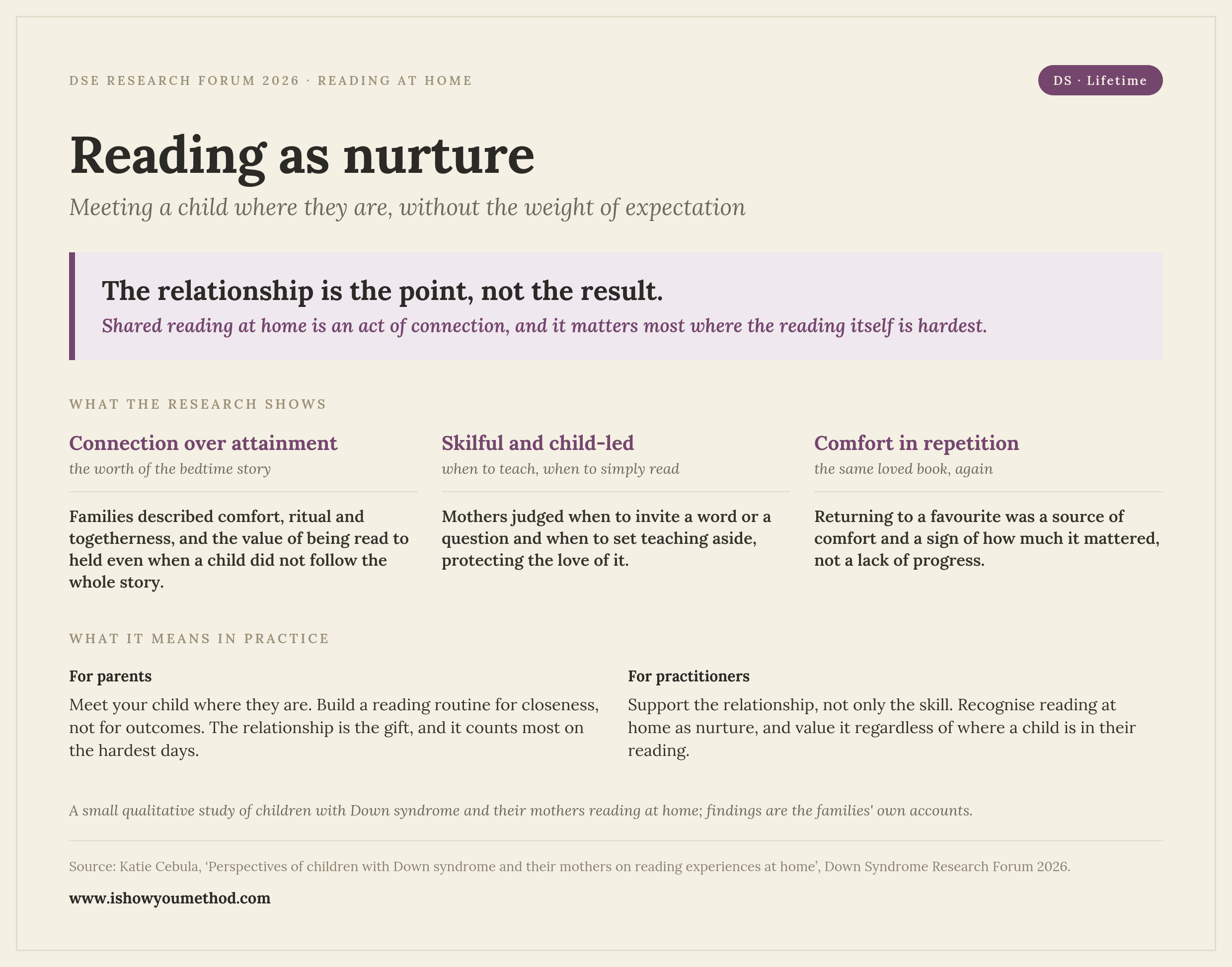
Start with what the families are already doing, because the evidence is clear and it matters for everything that follows. Katie Cebula's study of children with Down syndrome and their mothers reading at home asked the children themselves, and what it found is that shared reading at home is, as much as anything, an act of nurture. The bedtime story was ritual and comfort and the chat at the end of the day. Mothers read their children with real skill, knowing when to teach and when to set the teaching down and simply read, so that the love of it survived.
What stands out is that the value did not depend on the reading going well. The togetherness held even when a child did not follow the whole plot, because the being-read-to was the point. The relationship was the gift, and it was given most generously exactly where the reading itself was hardest. This is evidence, not sentiment: the love and the investment are already there, in the home, every day, whether or not the reading comes easily. Hold that in mind, because when the support a child needs fails to arrive, the missing piece is never the family's effort.
The stress we do not see
Down Syndrome Research Forum, Mar 2026. Redman, 'The accessibility of counselling for families and carers of children with Down syndrome.'
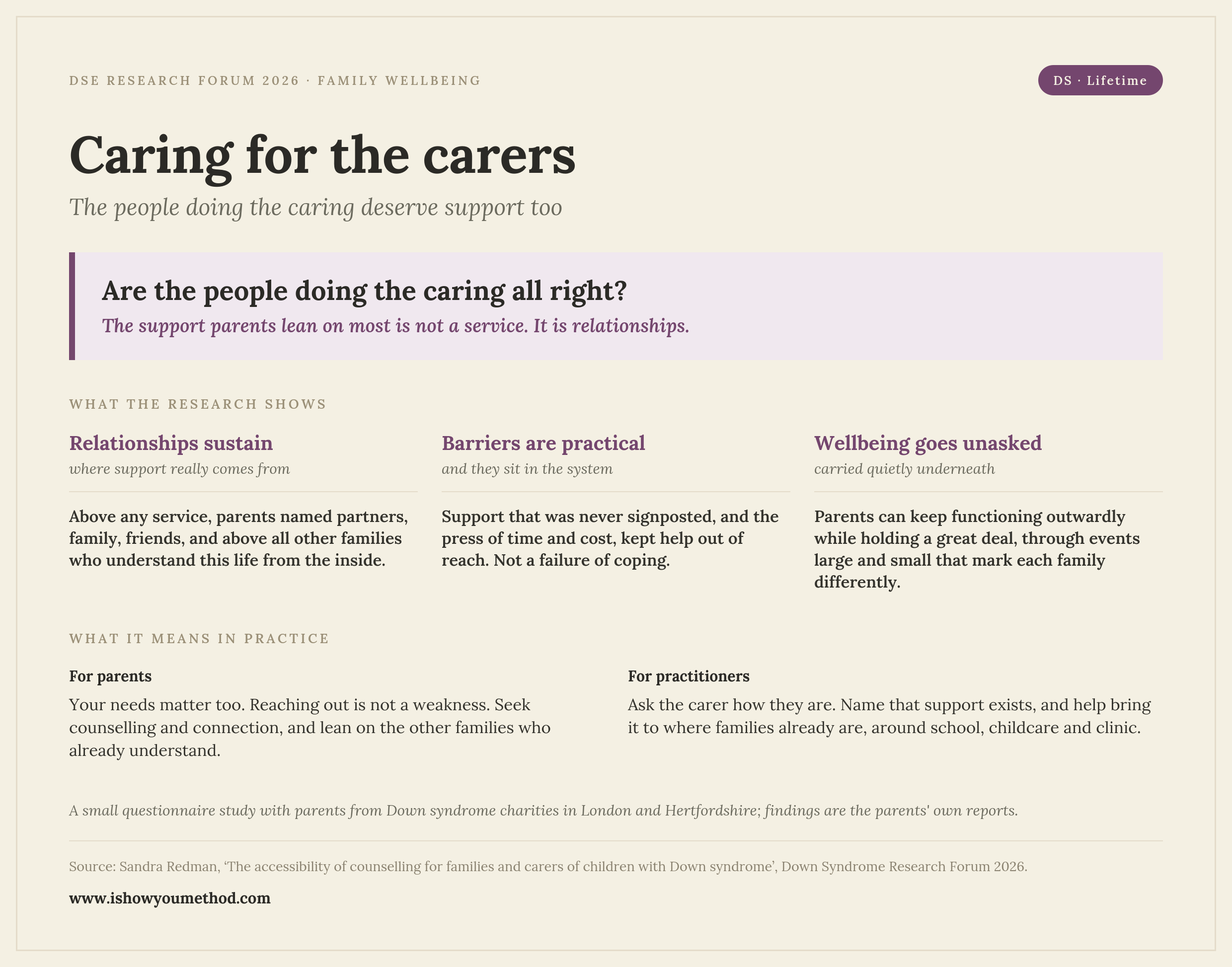
Alongside that warmth sits something heavier. Sandra Redman's work on the accessibility of counselling for families and carers asks a question the system rarely says out loud: are the people doing the caring all right?
She spoke about trauma with care, the big and the small of it, the medical events and admissions and surgeries that families move through, and she was clear that it looks different for every family; what marks one deeply may pass another by. Parents can keep functioning on the outside while carrying a great deal underneath.
What she found about support is worth holding onto: the help parents lean on most is not a service but relationships, a partner, family, friends, and above all other families who know this life from the inside. This Forum has, to its credit, made room for parent experience and for the need to support parent vulnerability. That is real progress, and it matters.
Citation: Redman, S. "The accessibility of counselling for families and carers of children with Down syndrome." [Conference presentation]. Down Syndrome Research Forum 2026.
The reckoning
Down Syndrome Research Forum, Mar 2026. Shumway and colleagues, 'What is the causal effect of placement in Mainstream versus Special secondary school on the health and education outcomes of adolescents with Down syndrome?'
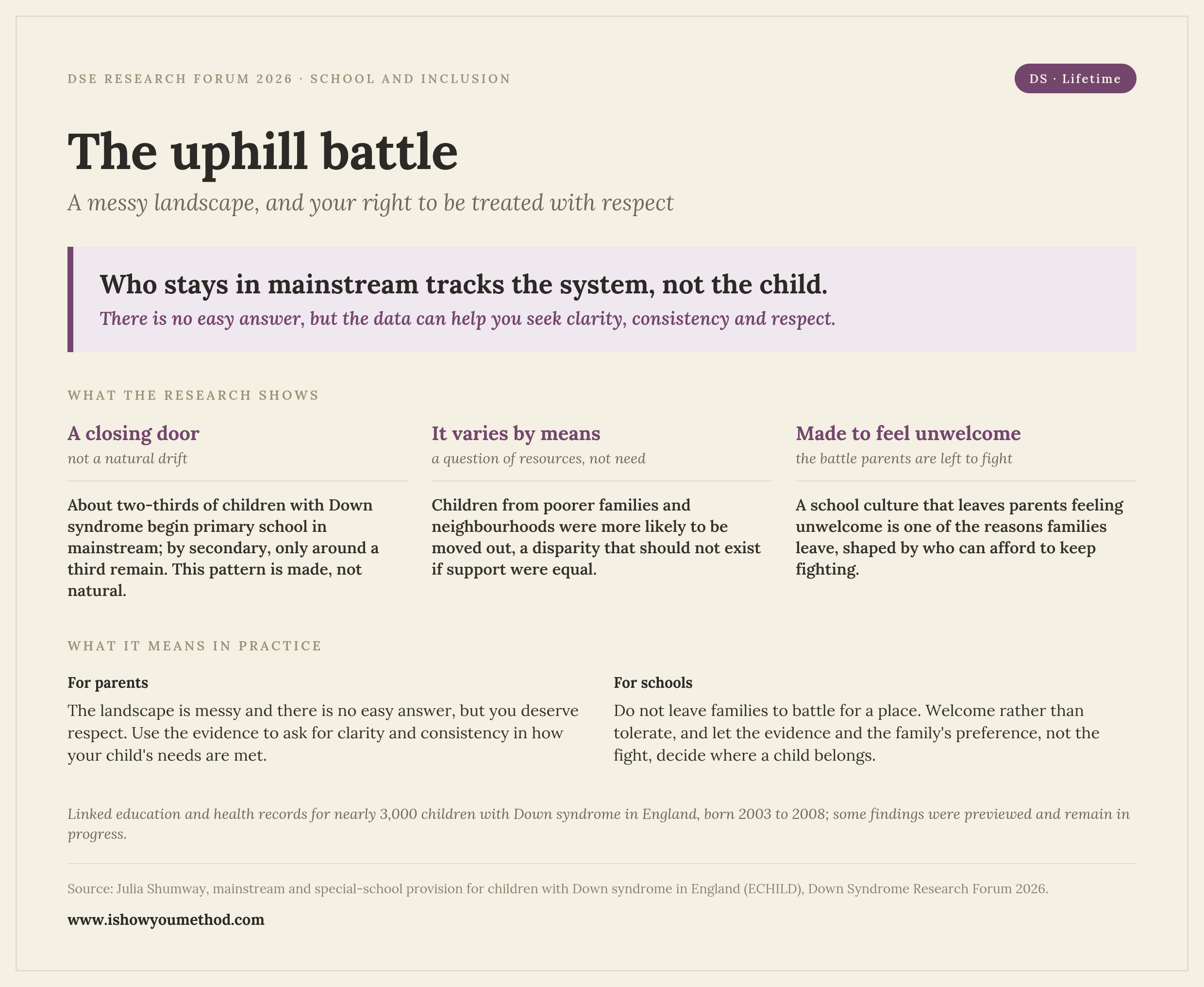
And then there is the talk that will not let the rest of us off so lightly. Julia Shumway followed mainstream and special-school provision for nearly three thousand children with Down syndrome in England, born between 2003 and 2008, by linking their school records to their hospital records. The headline pattern is stark. About two-thirds of these children start primary school in mainstream classrooms; by the start of secondary school only about a third remain. The proportion does not drift, it flips. An exodus on that scale bears scrutiny.
Some of it is, legitimately, choice. There is evidence that younger primary-age children with Down syndrome do better on literacy, numeracy and language in mainstream settings, though that evidence thins as they grow older. And there are real differences between settings in the felt sense of community and in access to resources: a special school may offer more specialist facilities, while a mainstream school may offer a child their own neighbourhood, recognised on the high street and counted among their friends. Whatever the right balance for any individual child, most of us would agree it should be led by the evidence, by parent preference, or by both. The study surfaces exactly those questions of community and resources, and to that extent it describes parents choosing.
But there is a third reason, and it is pernicious. It is, to my knowledge, the lived experience of very many parents of a child with Down syndrome, and it is a systemic hostility that mostly gets glossed over. There is a particular weight in hearing it not from a parent but from an academic, simply reading out what the data shows: that teachers and administrators can leave parents feeling unwelcome, and that parents who enrol a child with Down syndrome in a mainstream school "often face an uphill battle."
A battle. Because their child has Down syndrome. A battle that correlates with two-thirds of these children leaving mainstream, and an exodus that varies by socio-economic background. The study describes parents spending extraordinary time, energy and money to hold a mainstream place: stepping in to help teachers support their own child, paying privately for legal assessments, taking local authorities to tribunal, and in some cases writing the EHCP themselves to secure support that should simply have been provided. The parents who can sustain that fight tend to be the ones with the most time, money and confidence to spend on it. None of it appears on any official record.
Citation: Shumway, J. Ellis, J. DeStavola, B. Gilbert, R. Nguyen, V. Totsika, V. and Zylbersztejn, A. (2026) "What is the causal effect of placement in Mainstream versus Special secondary school on the health and education outcomes of adolescents with Down syndrome?" [Conference presentation]. Down Syndrome Research Forum 2026. Great Ormond Street Institute of Child Health, UCL, East London NHS Foundation Trust and Division of Psychiatry, University College London.
The second arrow
Down Syndrome Research Forum, Mar 2026 - reflection.
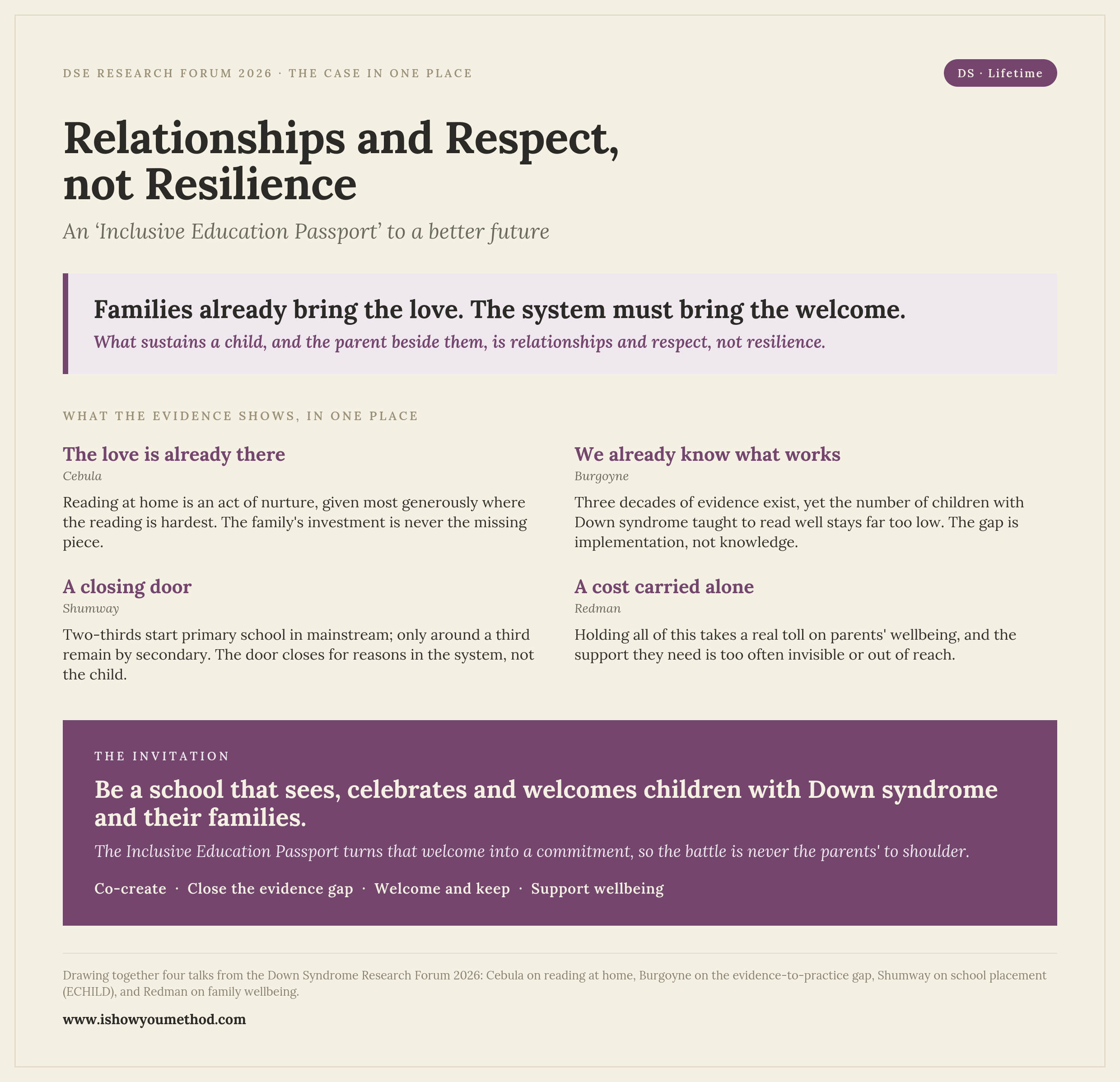
Set Shumway beside Redman and the question stops being rhetorical. Are the people doing the caring all right? How could they be, when one of the three reasons a family moves a child out of mainstream is a school culture that made them feel unwelcome in the first place? This is the part the warm version of the story leaves out. Behind the data are parents who, worn down, resign themselves to moving a child away from a place that child might have thrived in with the right support, not because it was the right call for the child, but because they did not have the funds, the stomach, or the reserves of mental health left to keep fighting.
There is a Buddhist idea of two arrows. The first is the pain that simply arrives and cannot be avoided. The second is the suffering added on top of it. The tidy reading of parent distress treats that second arrow as self-inflicted, the wound of a parent who was not resilient enough. I think that reading is wrong, and Shumway's data is why. The second arrow here is not fired by the parent. It is fired by a system built in a way that makes them feel unwelcome, and then asks them to be more resilient about it.
We already know what works
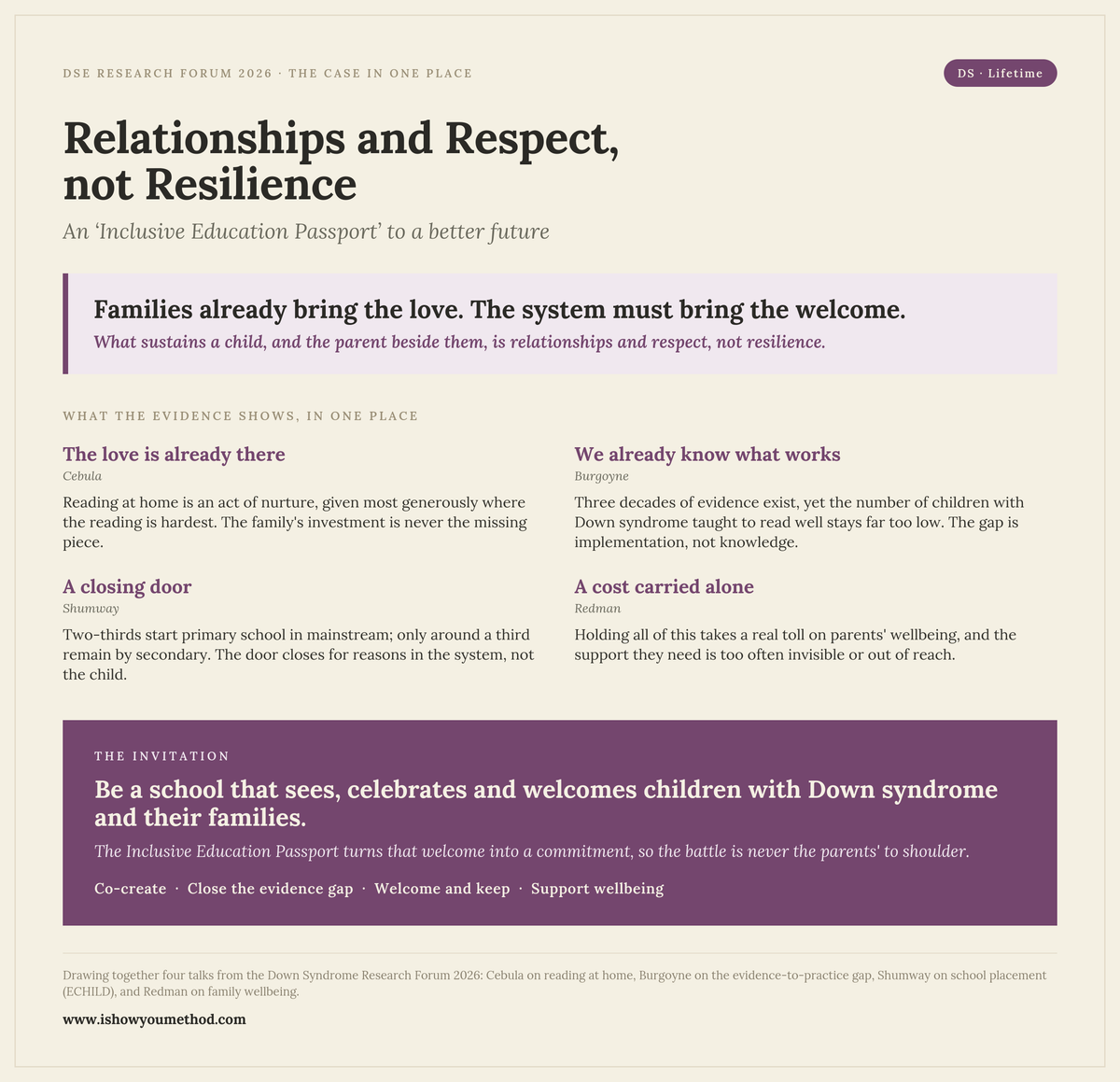
There is one more thing, and it is the part that turns this from sad to indefensible. None of it happens because we do not know how to help these children. Three decades of research, including the landmark randomised controlled trial led by Kelly Burgoyne, have established a great deal about how children with Down syndrome learn and how best to teach them. The knowledge exists. And yet, in the words of the team behind that very evidence, the number of children with Down syndrome taught to read well remains "shockingly low," set against the wider inequalities they face. They name the problem precisely: not a gap in knowledge, but a gap in implementation.
That is the why beneath everything above. The battles parents fight, the support quietly withheld, the children moved out of places they might have flourished in: none of it is the price of a problem we have not yet solved. It is the cost of solutions that do not reach the children they were built for.
Relationships and respect, not resilience
This is the whole of it, really. We keep reaching for resilience because resilience asks nothing of the system. What sustains a child, and the parent beside them, is not how much either of them can endure alone. It is relationships, and it is respect: whether a child is welcomed rather than tolerated, and whether the support that already exists actually reaches the family it was meant for.
That gap is the reason this work exists. Not to add another voice telling parents to try harder, but to stand alongside them, and to keep surfacing the lived experience of families and of individuals with Down syndrome, in their own terms, with the nuance that lets a person feel genuinely seen, heard and welcomed rather than merely processed.
And the evidence gives something beyond the indictment. When thousands of families respond and the same pattern comes back, what each of them lived in private is revealed to be shared. A single account can be doubted, weighed against another, or quietly explained away; a pattern across thousands of families cannot. That is what the research offers parents, and it is something they have rarely been given until now: the quiet dignity to name what is happening, to have their voice heard, and to have their needs met with respect rather than treated as a matter of opinion.
Seen, heard, welcomed. That has been the quiet spine of this whole series. I am ending it not as a description of three talks, but as a promise about what comes next.
Relationships and respect, not resilience.