Down Syndrome Research Forum, Mar 2026: Responsive Language Intervention. Early Vocalisation and later Vocabulary

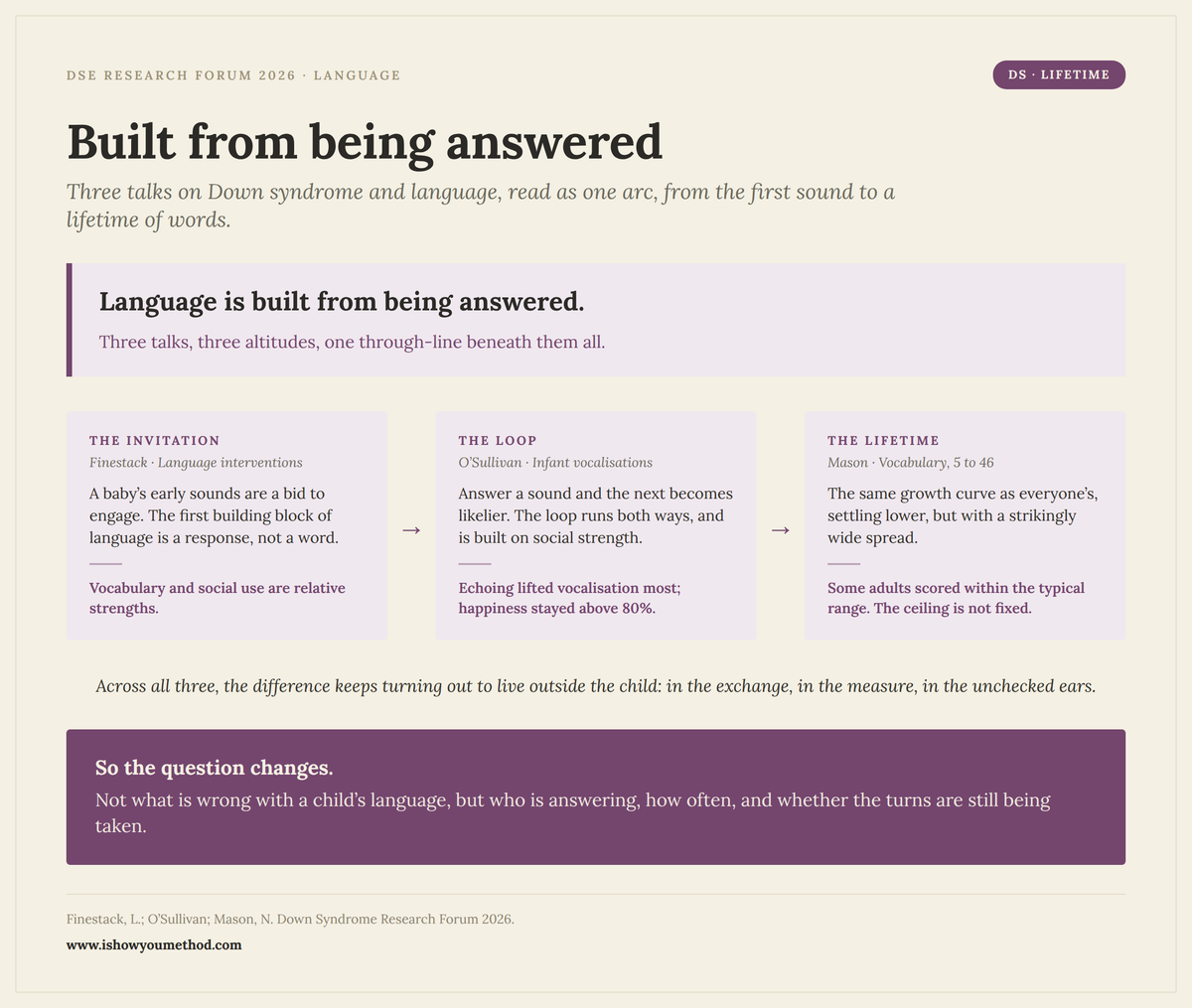
Three of the language talks at this year's Down Syndrome Research Forum sat at very different distances from the child: the whole language system, the earliest exchange between a baby and the person holding them, and the shape of vocabulary across a lifetime. I want to take each on its own terms. The thread I keep carrying from one to the next is small: language is built from being answered.
Before there are words
Down Syndrome Research Forum, Mar 2026. Finestack, 'Language Interventions for Children and Young People with Down syndrome.'
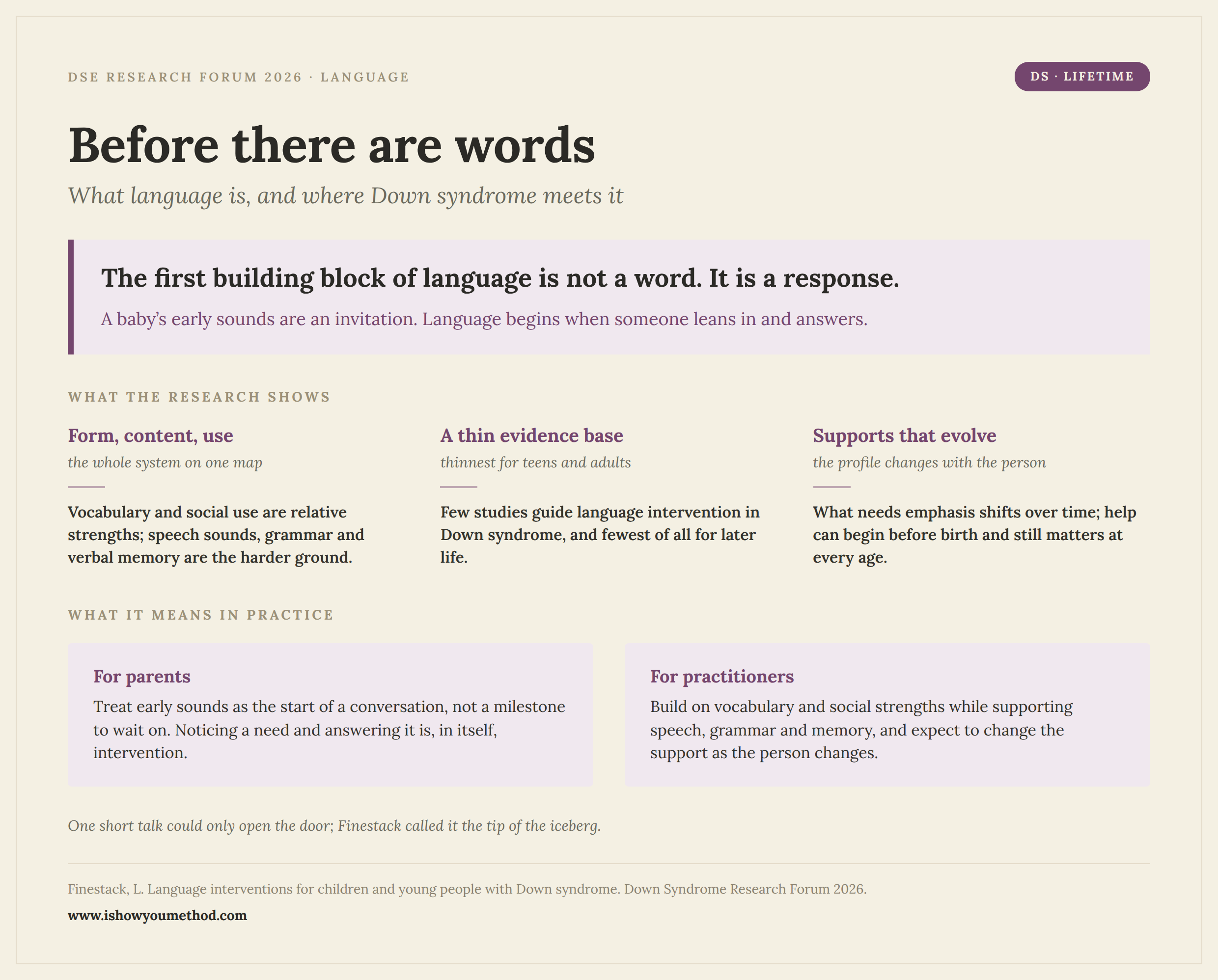
Lisbeth Finestack opened her Down Syndrome Research Forum talk with a walnut and a gentle warning: there is far more packed inside language than any of us tend to notice. Here is the tour. It's a long one. Mainly because there aren't any shortcuts, even with the simplified view:
Finestack built her session around six parts. A short look at language itself, and then each of its components in turn: sounds, meaningful units, sentences, vocabulary and social language. We treat language as one obvious thing and rarely stop to ask what it is actually made from.
Children with Down syndrome have known communication difficulties with language across the whole of their lives. Some aspects of language are harder than others, but there are relative strengths that can be built on. That helps to shape the exploration of language support for individual with Down syndrome.
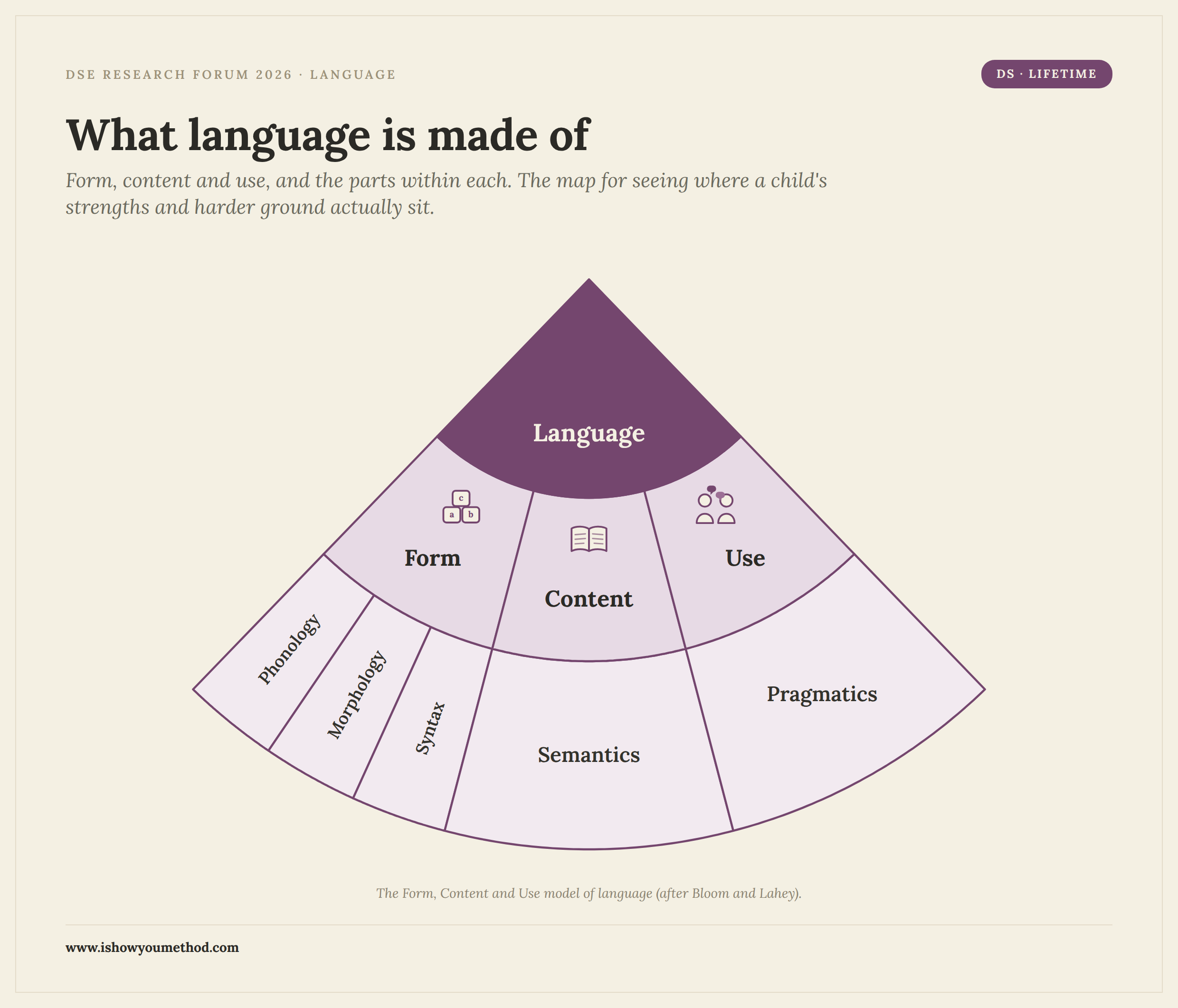
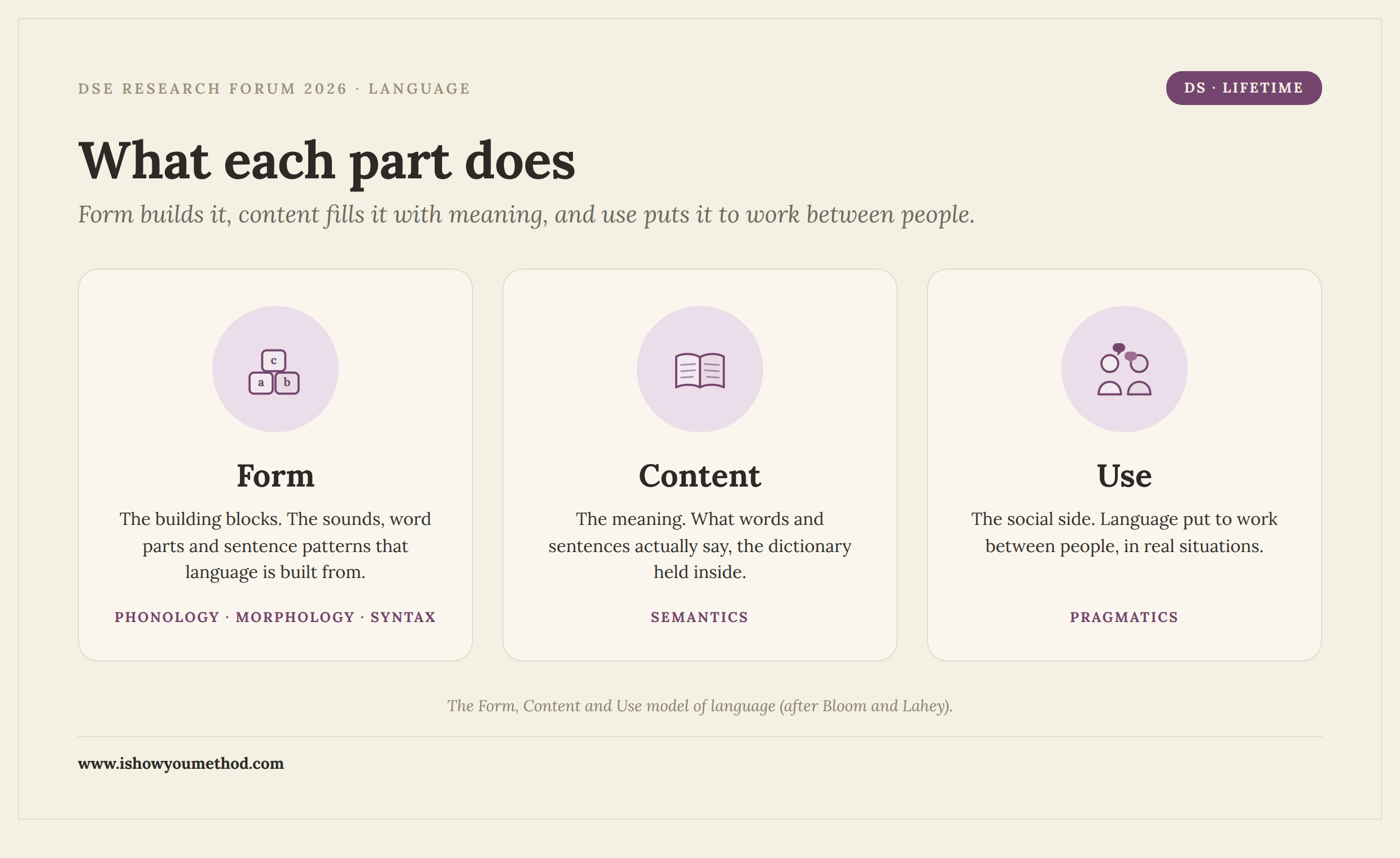
Language consists of form, content and use. Form is the machinery, the sounds (phonology), the smallest meaningful pieces such as tense endings (morphology), and the way words combine into sentences that hold together (syntax). Content is meaning, the personal dictionary each of us carries (semantics). Use is everything social, language put to work with other people (pragmatics).
Language is interactive; it grows in the space between a person and their world. It leans on thinking and memory, on the planning side of the brain, on motor skills, on hearing and vision and general health, and all of those change across a life. So the support a person needs changes too. There is no single fixed picture to aim at.
Finestack was honest about the state of the field: there is strikingly little research on language intervention designed specifically for Down syndrome. She framed the rest of the talk around what we do know, taken one component at a time.
Sounds: phonology
A phoneme is the smallest unit of sound that changes a meaning. Swap the first sound of cat for another and you get bat; that single switch is the whole difference. English runs on more than forty such sounds, and every language has its own set, governed by intricate rules about how they may be blended into words. It is a lot to coordinate.
For children with Down syndrome, the early babble that underpins all later communication tends to arrive a little later and a little more sparsely than for other children. Producing the sounds accurately can also be harder, partly for reasons of fine motor control, which can make speech more difficult for others to follow. The reason the sparseness matters so much is what those first sounds do: a baby's noises are an invitation, the cue that prompts an adult to lean in and answer. Fewer sounds mean fewer of those invitations, and so fewer of the back-and-forth exchanges from which language is built.
Intervention insights - before there are words. A promising approach treats every noise a baby makes as if it were already an attempt to talk, and answers it. This is the principle behind the "babble" programmes Finestack has been involved in, originally developed for another group of children and now being trialled with babies who have Down syndrome. The approach is deliberately proactive: rather than waiting for a delay to show itself, a speech and language professional coaches the caregiver, in short and regular sessions delivered from home, to respond to the child's vocalisations, to flood the day with naming and narration, and to keep the exchange going. When the adult answers more, the baby tends to vocalise more, which draws another answer, and the loop builds on itself.
Meaningful units: morphology
Morphology is the level of the smallest meaningful pieces. The ed that puts a verb in the past, the s that makes a plural, the un that flips a word's meaning. Mastering these endings is harder for many children with Down syndrome, who tend to leave them off, so that speech can sound clipped or telegraphic and writing carries the same gaps. Because the difficulty often persists into adulthood, Finestack's reading is that it needs to be taught directly rather than waited out. It matters well beyond speech, too: those small markers carry a lot of the meaning that reading and writing depend on.
A handful of studies have tested ways of supporting grammatical forms in Down syndrome specifically. Camarata and colleagues (2006) worked with children aged roughly four to eight, folding the missing grammatical information back into what the child had just said. Moraleda-Sepúlveda and colleagues (2013) did similar work with Spanish-speaking children aged six to fourteen, targeting the language's many inflections. Hewitt and colleagues (2005) worked with three adults, focusing on pronouns and prepositions in English.
Intervention insights - language techniques. What these studies share is that none of the methods were invented for Down syndrome. They are long-standing approaches that clinicians use across many groups of children who find language hard to master. Three sit at the core. Modelling simply raises how often the child hears the target form. Imitation invites the child to say it back. Recasting takes what the child has just said and feeds it back in fuller or more correct form, so a child's "yesterday she walk" is answered with "yes, yesterday she walked." Two more are often layered on top: corrective feedback, a kind, clear signal that something was not quite right alongside the right version, and explicit rule presentation, naming the pattern outright, for instance that an action already finished takes that ed on the end.
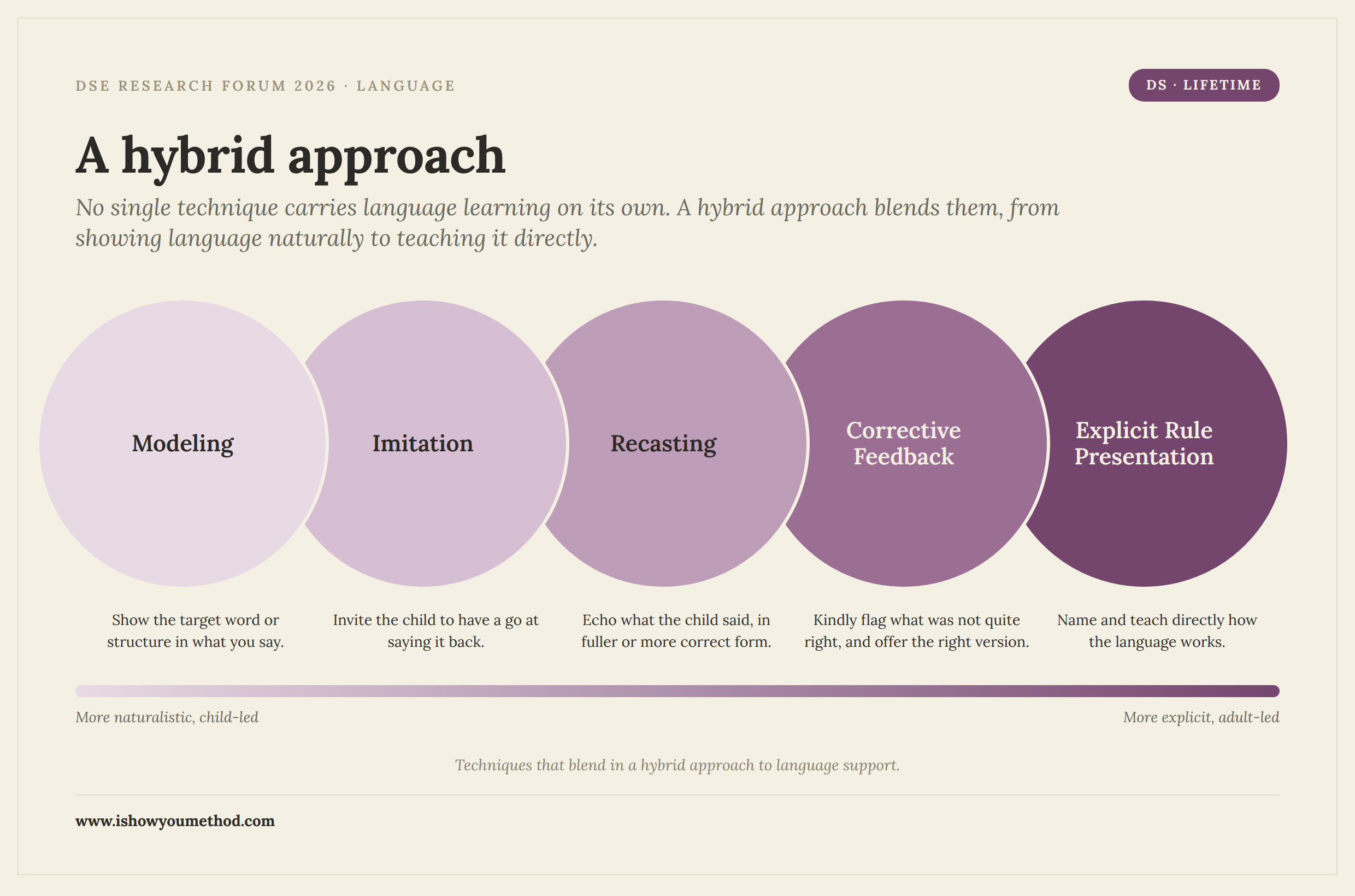
In her own studies, Finestack has built these techniques into short sessions, around twenty minutes, that move through several activities: a sentence-imitation task to rehearse the target forms, a supported story retell where the child tells a story back with pictures and prompts to lean on, a stretch of play engineered to invite the target form, and a spell of simply listening to lots of examples, giving the brain a chance to consolidate what it has been learning.
Sentences: syntax
Syntax governs word order and the way words assemble into sentences. Building that complexity tends to be one of the harder areas in Down syndrome.
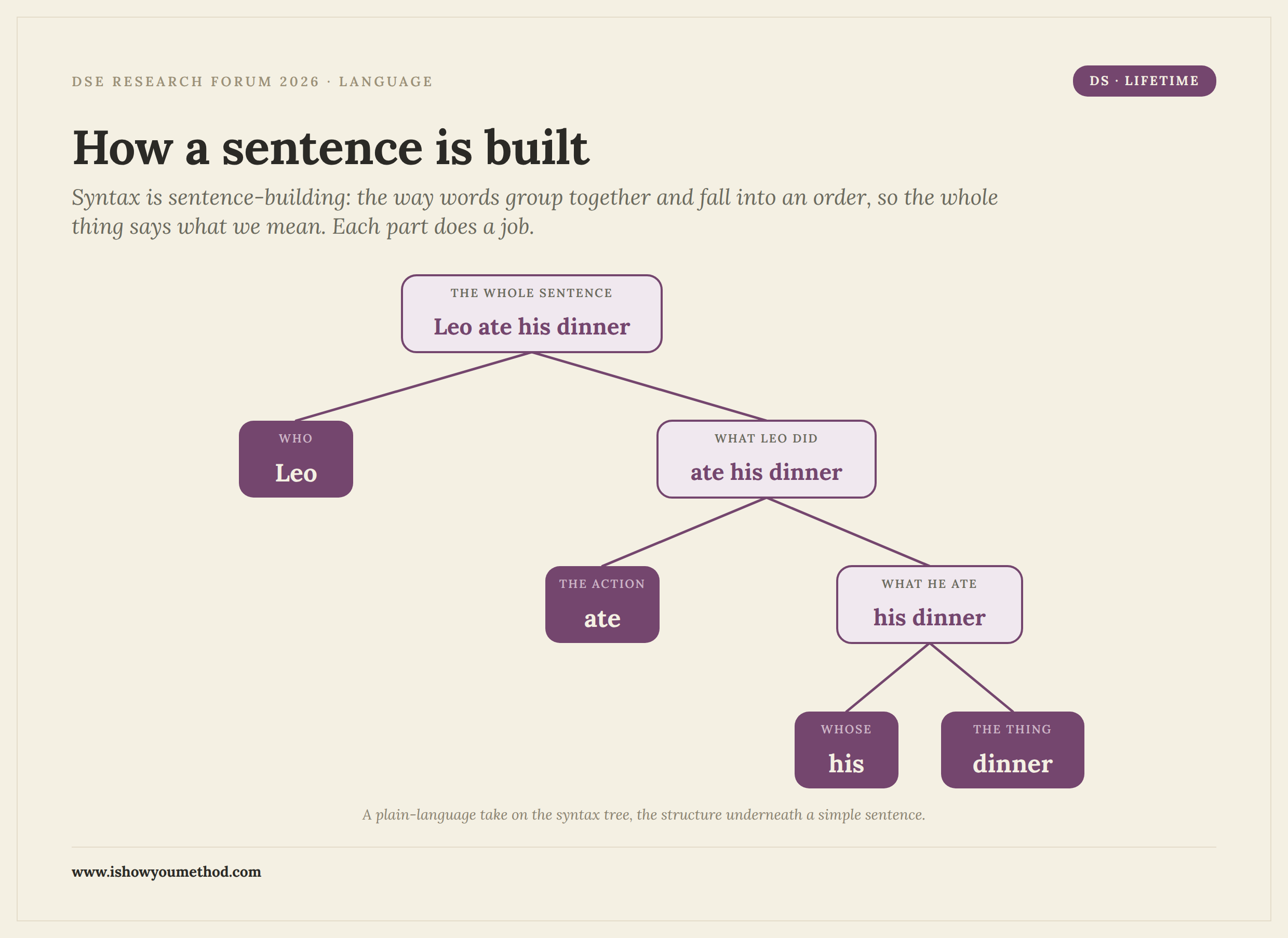
Intervention insights - stories stronger than sentences. The picture depends on how you look. Standardised assessments and ordinary conversation samples tend to show simpler forms and short word combinations. Yet ask the same young people to tell a story, with support, and noticeably richer language appears. The capacity for more complex sentences is there; it shows up more readily in some settings than others, which is a reason to support language across a range of contexts rather than judge it from one.
Intervention insights - Recast with younger children. Recasting does useful work here too: take a two or three word utterance and hand it back expanded, and you show the next rung of complexity without correcting the child.
Intervention insights - multimodal AAC supports complexity. Language complexity requires more intensive support than vocabulary work. Finestack pointed to augmentative and alternative communication, or AAC, as the critical enabler. It can be unaided, drawing only on the body, through gesture or sign. Or aided, ranging from a simple picture card to a speech-generating device. It scaffolds and anchors language acquisition by taking full advantage of the visual, embodied and relational relative strengths for a child with Down syndrome.
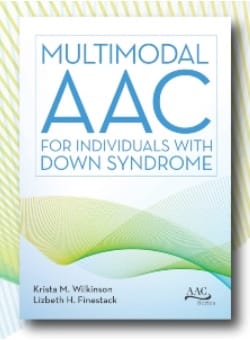
The guiding idea is to value every mode of communication, and to make sure families know that writing something down, a gesture, body language, a facial expression, a picture or a device are all legitimate ways to support a child's language. Finestack's edited book on multimodal AAC in Down syndrome, written with Krista Wilkinson, gathers eleven chapters on exactly this, across early childhood, school and adolescence.
Vocabulary: semantics
Semantics is vocabulary, the rules that give words their meaning and let them combine. First words tend to come later in Down syndrome, often around eighteen months rather than a child's first year, though the variation between children is wide. New words can then be picked up relatively quickly but the meaning associated with the word may not follow. Importantly, vocabulary keeps growing through adolescence and into adulthood, and it is a relative strength in Down syndrome compared with grammar and syntax, which makes it something to build on.
Intervention insight - interactive narrated learning. For the youngest children, the engine is the caregiver: naming people and objects, narrating what is happening, drawing attention to things in the room. The more of that labelling, the better it supports both the words a child understands and the words they use.
Intervention insight - interactive immersive learning. For older children and teenagers, a place in a mainstream classroom, where the vocabulary on offer is far richer than in isolation. Plenty of external support when a new word appears, explaining what it means. Meeting a new word in many different settings, so its full range becomes visible. Pairing vocabulary with whichever AAC mode a child uses, which can enrich and consolidate learning.
Social language: pragmatics
Pragmatics is the social use of language, and in a sense it wraps everything else together. It runs on three kinds of rule. The first is using language for a purpose: to comment, to request, to draw attention, the many jobs we ask language to do, and that children need practice doing. The second is organising language into discourse, the shape of a story with its setup of who and where, its turning point, and its ending. The third is knowing what to say, when and how, the social etiquette of please and thank you, of asking for help, of asking someone to say a thing again when you have not understood.
These skills are both spoken and unspoken. The spoken side includes starting a conversation, taking turns, staying on a topic before moving off it, repairing a misunderstanding, matching how you speak to who you are speaking to, since a friend and a teacher call for different registers, and telling someone about an experience. The unspoken side includes eye contact and facing the person you are talking to, judging how close to stand, and reading gesture and expression.
Here Down syndrome brings a real strength. Social motivation and a pull toward connection are often pronounced, which is a wonderful foundation, because the social drive is itself a route into the rest of language. Some things are harder: taking another person's perspective, which makes repairing a breakdown more difficult; expressing oneself through gesture and reading others' nonverbal cues; and navigating the busier, subtler social world of adolescence, where a great deal happens beneath the surface for everyone.
Intervention insight - AAC enrichment. If a young person uses AAC, give them a clear way to start a conversation themselves, so engagement is something they can initiate rather than only receive. Keep adapting the AAC as the person grows and as settings change, since what serves a child in primary school may not fit secondary school, or later a workplace, each with its own expectations. Make sure the people around the person know how to use the AAC alongside them, because that shared fluency is what turns a device into a conversation. And lean on AAC and visual supports especially when communication breaks down, as a second route to being understood.
What to carry away
Language is many-sided, and it does not sit in isolation; it is bound up with thinking, movement, health and the environment a person is in. Children with Down syndrome can benefit from rich language and communication from the first months of life, and the most powerful early move is simply to make that linguistic environment a generous one. Where the evidence base is thin, well-established, traditional approaches still help most children and young people. And weaving AAC through all of it helps each person reach further than speech alone might carry them.
Intervention insight - the response comes before the words. Proactively respond as if the babble, words, sentences are there: Notice what a person can already do, build on it. Make full use of the social, interpersonal and multimodal supports that can hold and shape the complexity. Scaffold, expand and recast language attempts, so that individuals with Down syndrome can develop the meaning not just a collection of words.
Sepúlveda, E. M., López‐Villaseñor, M. L., & Heinze, E. G. (2013). Can individuals with Down syndrome improve their grammar?. International Journal of Language & Communication Disorders, 48(3), 343-349.
Hewitt, L. E., Hinkle, A. S., & Miccio, A. W. (2005). Intervention to improve expressive grammar for adults with Down syndrome. Communication Disorders Quarterly, 26(3), 144-155.
Camarata, S., Yoder, P., & Camarata, M. (2006). Simultaneous treatment of grammatical and speech-comprehensibility deficits in children with Down syndrome. Down Syndrome Research and Practice, 11(1), 9-17.
Wilkinson, K. M., & Finestack, L. H. (2020). Multimodal AAC for Individuals with Down syndrome.
What the answering does
Down Syndrome Research Forum, Mar 2026. O'Connell-Sussman and colleagues, 'Enhancing Infant Vocalizations: A Focus on Early Caregiver Interactions for Infants with Down syndrome.'
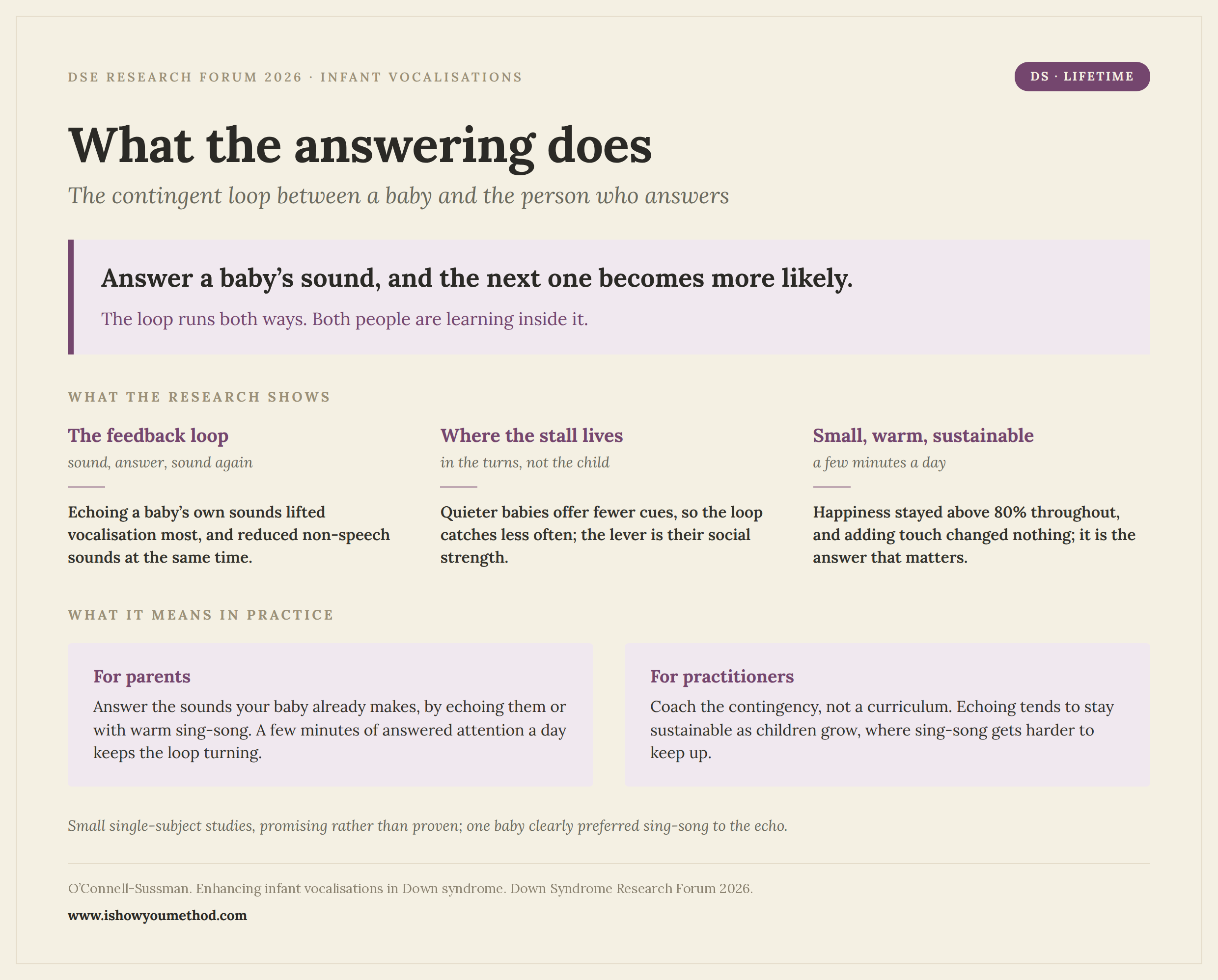
If language begins with being answered, this talk is about what the answering does, and it goes looking in the smallest possible unit: a baby and a mother on a sofa, ten minutes at a time. Three infants, given the cover names Picasso, Monet, and Pollock. An iPad propped out of view to film, and the researcher present in the room only through a single earbud in the mother's ear, coaching the back-and-forth as it happened. I find that image hard to shake. The intervention is a person, quietly in someone's ear, helping another person answer her child.
The mechanics are a loop. A baby coos, or babbles, or blows a raspberry, and the mother answers in kind, sometimes by echoing the exact sound the baby just made, sometimes with a high sing-song phrase, sometimes with a touch. The answer makes the next sound likelier, which draws the next answer. Babies with Down syndrome tend to make more of the non-speech sounds, the raspberries and gurgles, and reach the consonant-vowel babble of mama and dada later, so the loop has fewer chances to catch. But notice where that stall sits. Not in some absence in the child, but in the arithmetic of the exchange: fewer sounds, fewer answers, a loop short of turns. And the lever the work reaches for is a documented strength of these children, their social responsiveness, rather than a deficit to be drilled.
The findings are small and honestly held, single-subject studies with a few infants, results the team calls promising rather than proven. Echoing the baby's own sounds back tended to lift vocalisation most, and in an earlier replication it did two things at once, raising the speech-like sounds while reducing the non-speech ones. But the picture is not tidy. One of the babies plainly preferred the sing-song over the echo, and that preference was simply his. A counterintuitive result sat alongside it too: adding touch to the voice changed nothing measurable, so it was the kind of vocal answer that mattered, not the extra channel. And beneath the counts they tracked a softer measure I keep returning to. The infants' indices of happiness never fell below eighty percent. A few minutes a day, costing almost nothing, of warm and answered attention the baby was visibly enjoying.
One last observation pointed forward. As children grow, the sing-song of motherese gets awkward for caregivers to keep up, while echoing a child's sounds stays natural, which may make it the more sustainable answer over time. If this loop is where language starts, the question is what a lifetime of it, or a lifetime short of it, builds toward.
The long arc
Down Syndrome Research Forum, Mar 2026.Mason and colleagues, 'Vocabulary size in 5- to 46-year-olds with Down syndrome.'
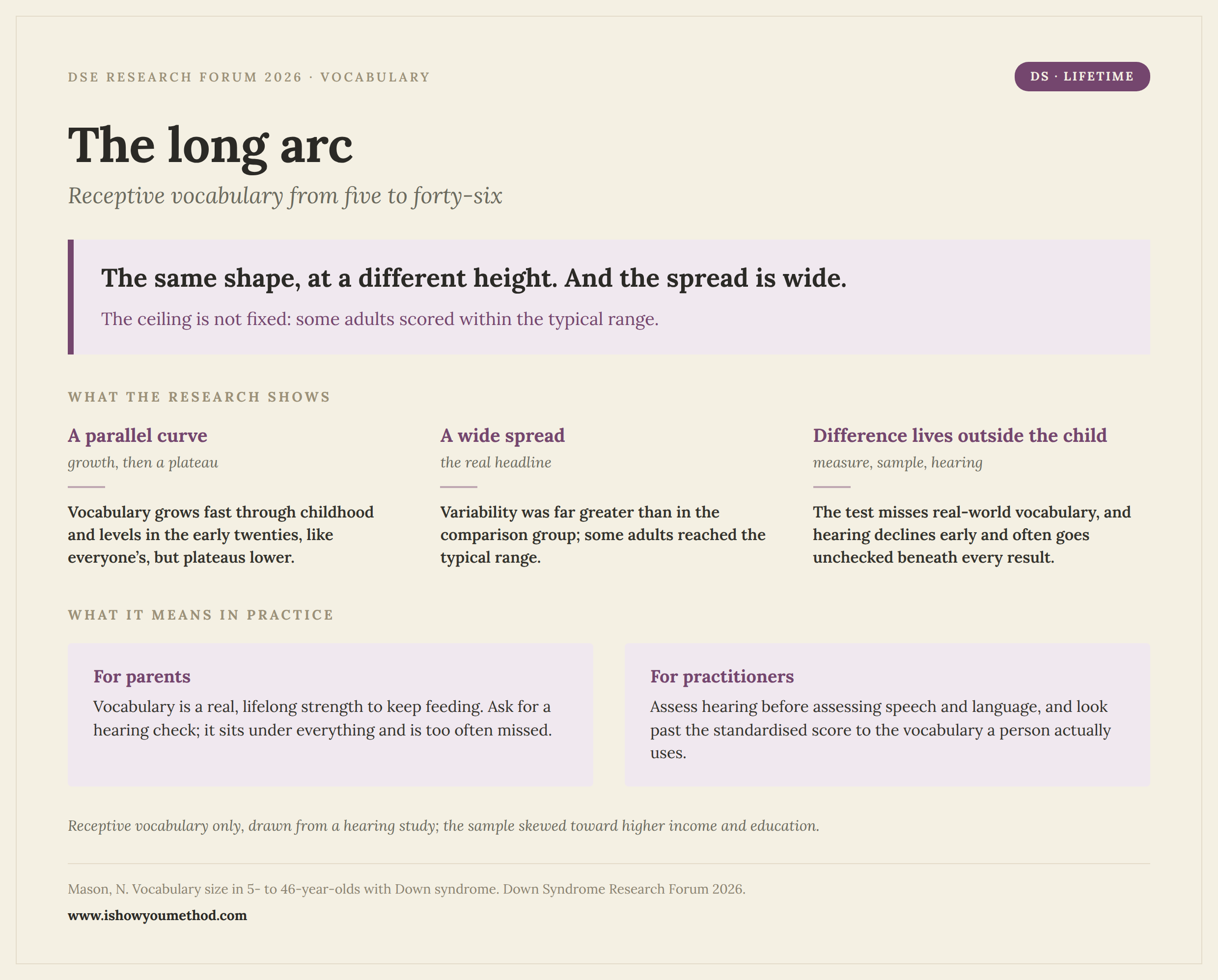
Natalie Mason's talk follows the answer all the way out, from five years old to forty-six. To reach the people most studies miss, her team loaded their assessment into a vehicle and took it on the road, gathering a community sample alongside the hospital one, close to a hundred people with Down syndrome and a comparison group of roughly the same size. The test itself is humble: the Peabody, where you hear a word and point to one of four pictures. Receptive vocabulary, the understanding side, which is one of the relative strengths in the Down syndrome profile, and the only side this study could see, because the vocabulary data was a by-product of a larger study about hearing.
The curve she found has the shape everyone's does: rapid growth through childhood and adolescence, then a levelling in the early twenties. The same shape, at a different height; the plateau settles lower, a raw-score gap of around seventy points. Her own one-line answer to whether the trajectory matches was "yes and no," yes in shape, no in level. But the finding that holds me is the spread. The variability among the adults with Down syndrome was wide, far wider than in the comparison group, and a handful of them scored squarely within the typical range.
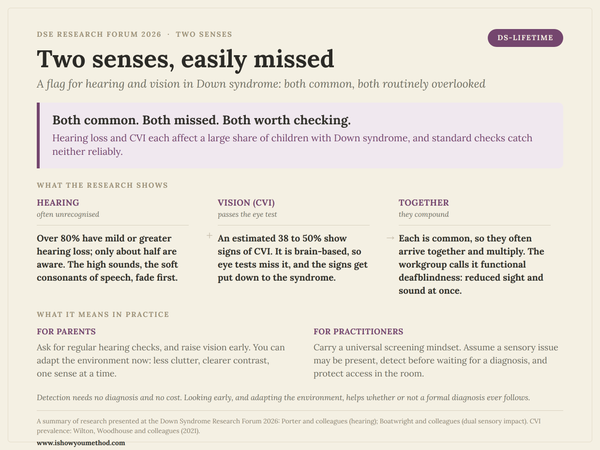
That spread is the real headline, and Mason is honest that her study cannot explain it. She points at what the Peabody cannot see: picture someone who works in a coffee shop, she said, with a rich and exact vocabulary for that entire world, none of which a standardised picture test was built to catch. She points at a sample that is not representative, skewed toward higher household income and higher maternal education. And she points, hardest of all, at hearing. In Down syndrome it can decline early, earlier than in peers and, as one comment in the room had it, perhaps by decades, and it goes too often unchecked in adults, sitting underneath every one of these outcomes. The discussion afterwards put it more sharply still: hearing should be assessed before we ever assess speech and language, and it rarely is. The difference, here as in all three talks, keeps turning out to live outside the child: in what we measured, in whom we managed to reach, in whether anyone thought to check the ears.
So I will end where the thread does. The ceiling is not fixed; the spread is the proof. The strength is real and already there to build on. And the earliest, cheapest, most human part of the whole picture is the loop of being answered. None of this proves that the back-and-forth of infancy is what separates the adult in the typical range from the one who plateaus early, and the researchers are far too careful for me to pretend it does. But it changes the question. It stops being what is wrong with a child's language, and becomes something quieter and harder, and ours rather than theirs: who is doing the answering, how often, and whether the turns are still being taken.