Down Syndrome Research Forum, Mar 2026 Hearing and Cortical Visual Impairment

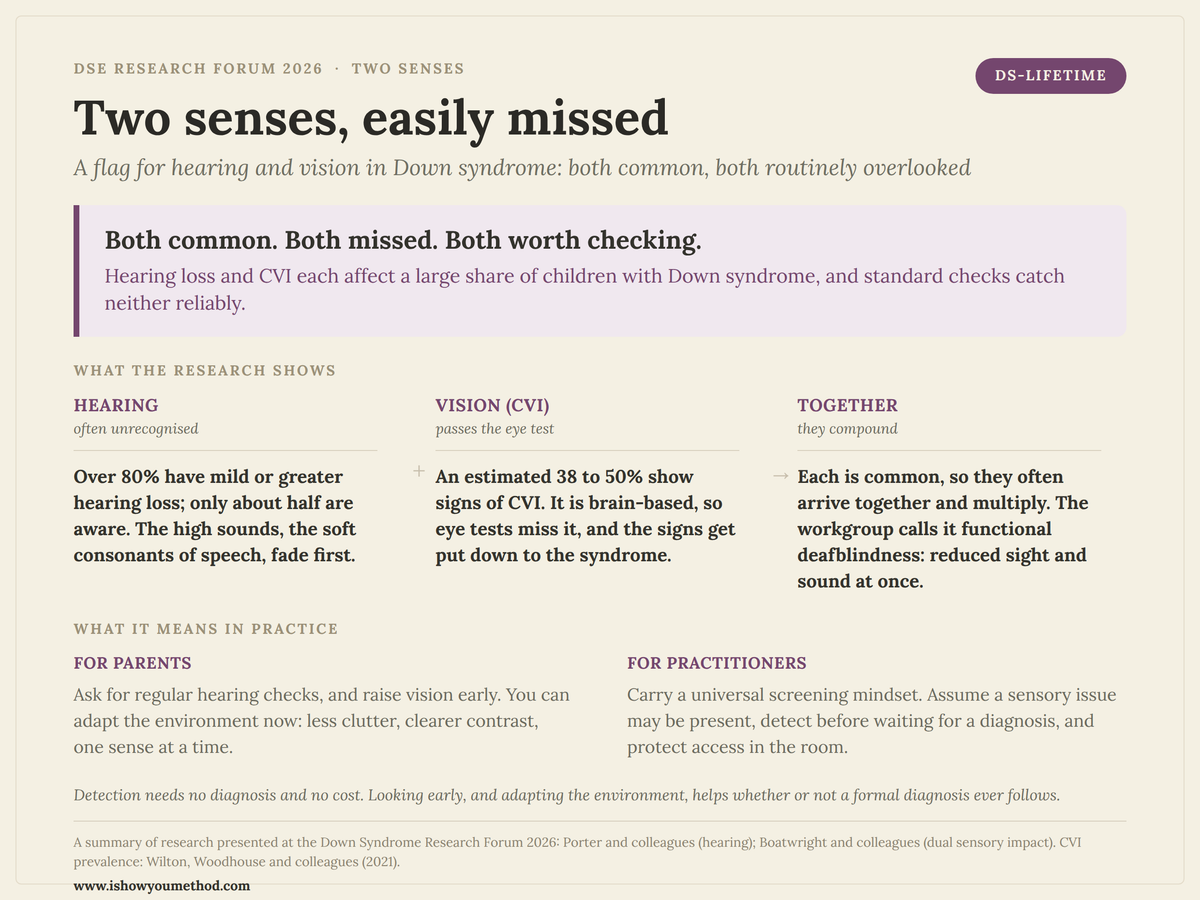
What We Are Not Hearing
Down Syndrome Research Forum, Mar 2026 Porter and colleagues 'Characterizing hearing in children and adults with Down syndrome.'
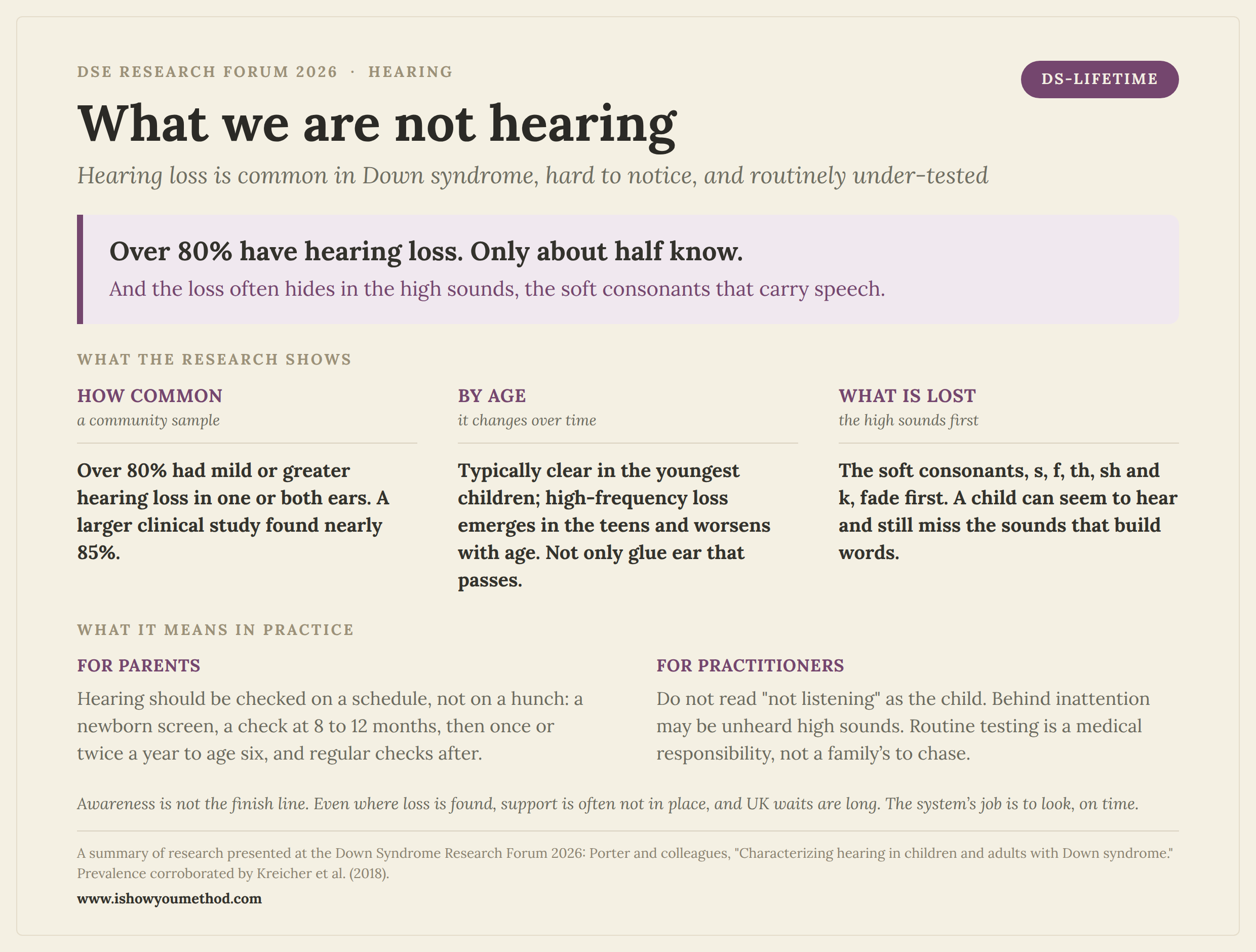
A study from the Down Syndrome Research Forum 2026 found that most of the children and adults it tested had hearing loss, and only about half were aware of it. That gap is the whole story, and it is not the gap you might assume.
There is a child every teacher pictures without effort. Slow to answer. Adrift at carpet time. Missing the instruction that everyone else seemed to catch, fading by the afternoon. When that child has Down syndrome, we tend to reach for a ready explanation and file the behaviour under the syndrome. One of the talks at this year's forum gave me a reason to pause before reaching.
Heather Porter and her colleagues at Boys Town National Research Hospital and the University of North Carolina set out to measure hearing in a way most earlier work had not managed. Previous studies leaned on medical records or clinic populations, which over-represent people who already suspect a problem. Porter's team instead recruited 107 children and adults with Down syndrome, aged five to fifty-five, through family organisations, community events, social media and word of mouth. These were not people who turned up because something was already known to be wrong. This is closer to ordinary life.
The finding that stays with me is the gap between reality and awareness. Over eighty per cent of participants had mild or greater hearing loss in one or both ears. Only around half of those participants, or the people caring for them, were aware that any hearing loss was present. For a large share of these individuals, a measurable change in how they reach the world of sound had simply gone unrecorded. And here is the part worth saying plainly: that is not a failure of attention by the people who love them. High frequency hearing loss in particular is genuinely hard to notice from the outside. It arrives quietly, without the dramatic signs we picture when we imagine a child not hearing. It is exactly the kind of thing you detect by testing for it on schedule, not by waiting for someone at home to spot it.
The pattern across age is worth naming, because it carries a hopeful instruction. Hearing was broadly typical in the youngest children, the five to ten year olds. High frequency loss began to appear in the eleven to twenty group and worsened with age. The window to catch it early is real. Routine assessment is worth doing even when nothing seems obviously wrong, precisely because this kind of loss can arrive quietly and build over time. Conductive loss, the kind often linked to middle ear fluid and infection, was more common at lower pitches, while the higher pitches showed more sensorineural loss, especially in older participants. So the easy assumption that hearing loss in Down syndrome is only ever glue ear that will pass does not hold.
It is worth pausing on what high frequency loss actually takes from a child, because the phrase sounds technical and almost harmless. The high frequencies are where the quiet, consonant sounds of speech live, the s, f, th and sh that we lean on to tell one word from another. Audiologists map this with a picture they call the speech banana, the curved band on a hearing chart where the sounds of speech fall. The vowels and the louder, lower-pitched sounds sit down in the body of the banana. The soft consonants sit up in one corner, high-pitched and quiet, in the very same place as birdsong. That corner is the first to go. So when we say a child has high frequency hearing loss, we are often saying something quite specific, and quite serious: the sounds that carry meaning, the building blocks of spoken words, may be the ones they are missing, while the louder vowels come through fine. A child can seem to hear, and still not catch the parts of speech that let them learn to talk.
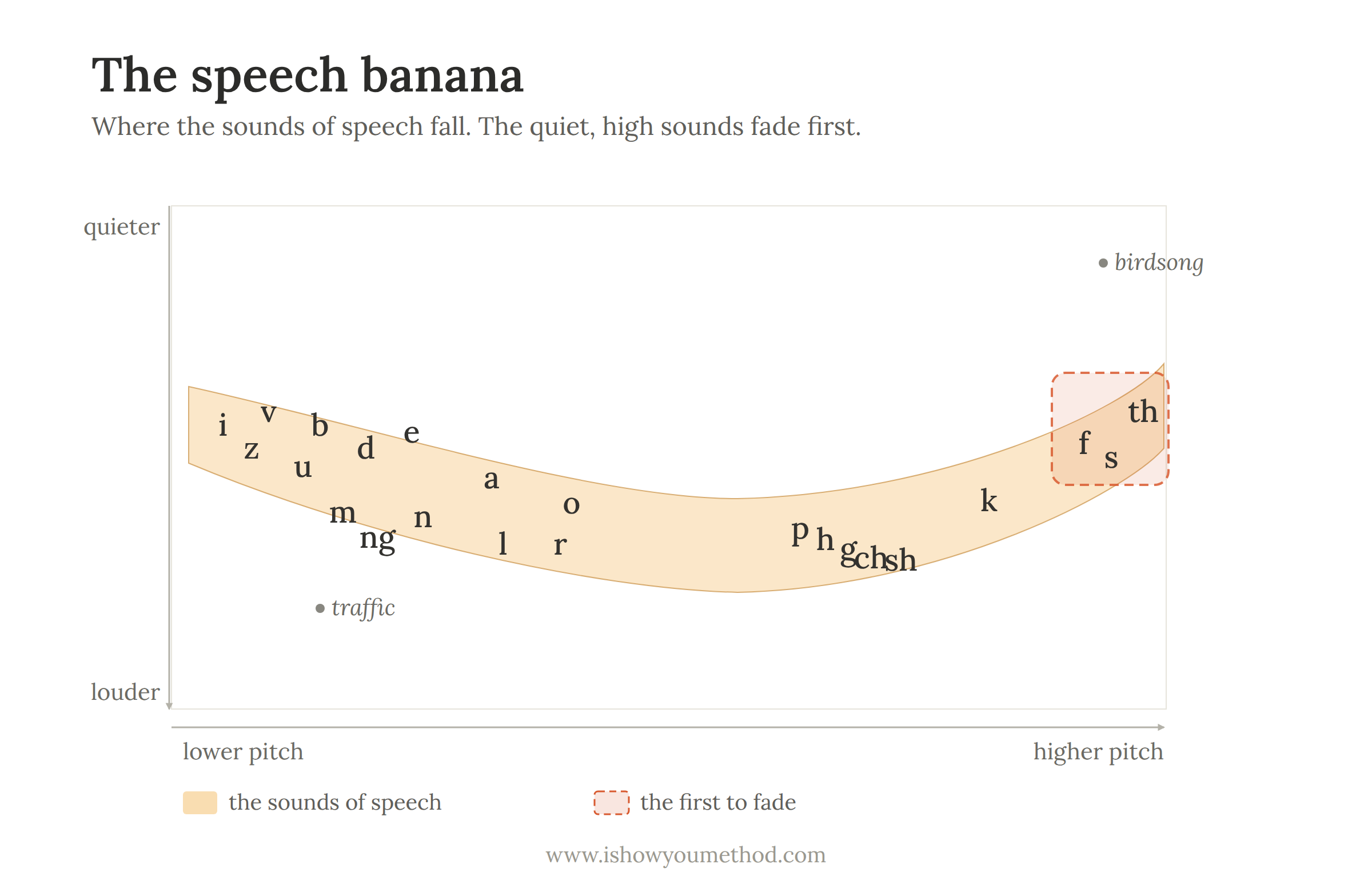
The speech banana: where the sounds of speech fall on a hearing chart. The soft consonants, high and quiet, share the corner with birdsong, and that corner fades first.
And awareness, it turns out, is not even the finish line. Even where hearing loss had been identified, support such as hearing aids was frequently not in use. Identifying a need is one thing. The system actually following it through to support is another.
What I take from this is not a story about a deficit inside the child. It is a story about a system that does not routinely look. An unmet hearing need is easy to mistake for inattention, slowness, or withdrawal, because that is exactly how it looks from the outside. The child who seems not to be listening may be a child who cannot fully hear, in a room we never thought to check.
The practical response is not complicated, but it is easy to put on the wrong shoulders. Yes, the answer is to test hearing early and keep testing it, across childhood and into adult life, whether or not anyone suspects a difficulty. But that is not a small or private task to be left to families. It is a medical responsibility, and it belongs to services. Children with Down syndrome carry a known, elevated risk of hearing loss, and a known risk is precisely what routine surveillance exists for, in the same way we monitor for the other health conditions associated with the syndrome. A dependable, scheduled hearing programme should be the thing a family is simply enrolled in, not a thing they have to find out about, request, and then push for.
And in the current reality, pushing is often not enough. In the UK, long waits and delays across audiology and paediatric services are common, frequently the norm rather than the exception. A family can do everything asked of them, request the check, follow it up, ask again, and still wait many months past the point it was due. So when a child's hearing loss goes unrecorded, the honest reading is almost never that a parent failed to do the simple thing. It is that the system whose job was to look, on time and as a matter of course, did not. Building the whole safety net out of caregiver awareness was the wrong design from the start. The awareness gap is a system gap.
None of this requires a new theory of the child. It requires that the people whose job it is to look, look, on time, and then act on what they find.
Seeing Happens in the Brain
Down Syndrome Research Forum, Boatwright and colleagues 'Dual Sensory Impact in Down syndrome: Unlocking Developmental Potential (alternate title: Dual Sensory Impact in Down syndrome: Implications for Function, Language, and Learning).' Boatwright & Lawrence 'See it: What are CVI and Dual Sensory Impact in DS?' Saenz & Banihani 'Find it: Identifying CVI/dual sensory impact in DS.' Willems & Pilling 'Use it: Practical Strategies to Address CVI/dual sensory impact in DS.'
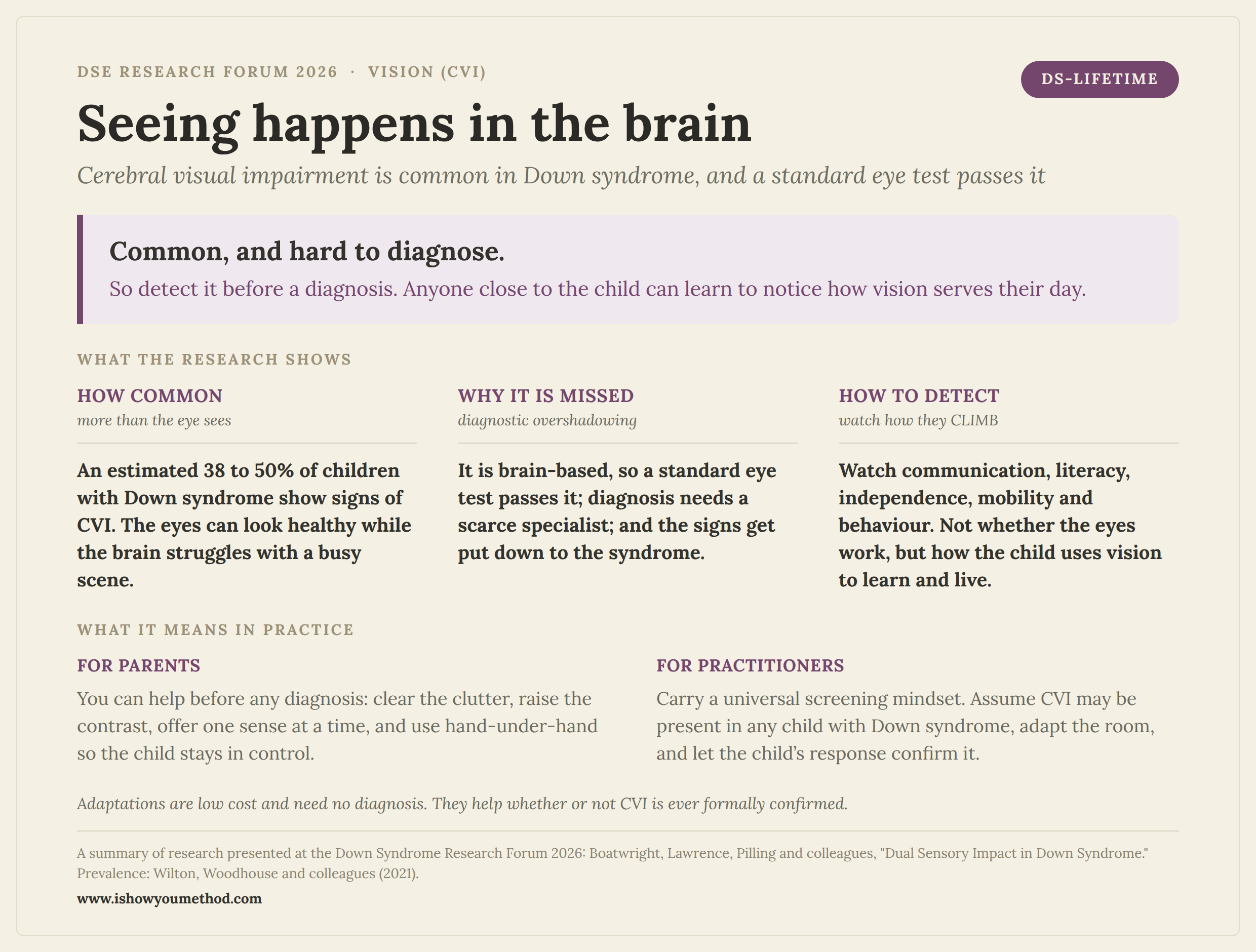
A condition common in Down syndrome, affecting by the researchers' own estimate somewhere between a third and a half of children, is routinely missed by a standard eye test and is genuinely hard to diagnose. The hopeful part is that you do not need a diagnosis to start helping. You need to know how to look.
Picture the child. Overwhelmed in a busy room, slow to find the thing you are pointing at, drifting when the display board is crowded and three activities are running at once. Now add a detail. This child has recently passed an eye test. Vision, we are told, is fine. So we file the behaviour, once more, under the syndrome.
A multidisciplinary, multinational workgroup led by Elizabeth Boatwright, alongside ophthalmologists, paediatricians and specialist teachers, used their forum session to introduce a condition many readers will never have met, even those who have spent years working with children with Down syndrome. It is called cerebral, or cortical, visual impairment, usually shortened to CVI.
The single most important thing to understand is that CVI is brain-based, not eye-based. The eyes can be structurally healthy and visual acuity can test as normal, while the child still functions as someone who cannot reliably make sense of what they are looking at, because the difficulty lies in how the brain processes visual information rather than in the eye itself. This is exactly why a routine eye check misses it. The child passes, and still struggles.
CVI is characterised by visual fatigue, difficulty with visual complexity, and variable function when several senses are being asked to work at once. Hold that description against a primary classroom: bright walls, moving bodies, layered sound, instructions delivered while other things happen. It reads almost as a list of what a child with CVI finds hardest.
And this is not a rare or exotic problem in this population. The workgroup's ophthalmologist, Linda Lawrence, put the incidence of CVI in Down syndrome at somewhere between 38% and 50%. The lower figure matches the published screening study, which found suspected CVI in around 38% of the children whose families responded (Wilton, Woodhouse and colleagues, 2021); the upper figure is the clinical estimate. Lawrence was careful that it is not yet established whether Down syndrome itself causes CVI. What is clear is that the medical events common in a baby's earliest days, low oxygen, low blood sugar, raised bilirubin, are all recognised risks for it, and where any of those are in the history, that child is worth watching closely as what the clinicians call a CVI suspect.
Common, and yet hard to diagnose
Here is the bind. CVI is this common, and yet it is one of the harder things to get formally diagnosed. It is significantly underrecognised, the presenters were clear about that, and a formal diagnosis sits with a medical provider, usually an eye-care specialist who actually knows CVI, and those are scarce. So families can find themselves waiting a long time for a diagnosis, or never reaching one at all, while the child keeps struggling in a room nobody has thought to change.
The shift the workgroup urges is the part I want to put at the centre of this, because it changes who gets to help. Detection is not diagnosis. You do not need to be a specialist to notice CVI. Anyone in daily contact with the child, a parent above all, but also a teacher or a teaching assistant, can learn to spot the signs by watching how the child functions. The question quietly changes. It stops being "can this child see," which the eye test already answered, and becomes "how is this child using their vision to learn and to live." That is a question the people who know the child best are often better placed to answer than a clinic is. The presenters made it concrete with a simple mnemonic, CLIMB: communication, literacy, independence, mobility, and behaviour. Those are the five places to look. Not whether the eyes work, but whether the child can use their vision to connect with others, to read, to do things for themselves, to move confidently through a space, and to stay regulated rather than overwhelmed. Watch those, and you are watching the vision that actually matters to a child's day.
The reason it stays hidden even from them has a name the presenters were careful to use: diagnostic overshadowing. When a child already has a recognised condition, new or different behaviours get attributed to that condition alone, and the second thing, the thing nobody is looking for, is missed or misunderstood.
What detection looks like in practice
The workgroup structured their guidance as See It, Find It, Use It. Learn to recognise the signs, know where to refer, and in the meantime start changing the environment. It is that last step that turns worry into something a parent can do on a Tuesday, and the strategies are strikingly ordinary.
Clear the clutter. As one of the workgroup's ophthalmologists, Rachel Pilling, kept returning to, much of this is simply about making it easier: a less crowded visual field, one clear thing to look at rather than a busy wall of competing detail. Present materials with space around them and in a consistent place, so the child is not hunting through a crowded scene to find what matters. Use the child's strongest visual field. Build in visual and tactile anchors. And teach the salient features explicitly, rather than assuming the child can pick out the part that counts; what is obvious to us in a busy image may not be obvious to a brain that fatigues parsing it.
Two specifics are worth dwelling on, because they are small and they matter. The first is communication that does not rely on vision alone. Pairing speech with signs, and with tactile signs the child can feel, gives a child more than one way in when the visual channel is unreliable. The second is how we guide a child's hands. There is a real difference between hand-over-hand, where an adult takes the child's hand and places it on something, and hand-under-hand, where your hand rests underneath the child's and brings them gently to the object, leaving the child on top and free to lift their hand away at any moment. Hand-under-hand, a long-standing strategy from deafblind practice, keeps the child in control of the encounter, and it is far less frightening. That single change, from doing to the child to offering to the child, is the whole philosophy in miniature.
It helps to write what works into a simple functional vision profile that travels with the child, so that every adult who meets them, a new teacher, a swimming coach, a relative, starts from what already helps rather than from scratch. Good free resources exist for building one, from the Paediatric Cortical Visual Impairment Society, CVI Scotland, and Perkins.
Why this should be routine
Two things make this genuinely practical. First, these strategies are low or no cost, and they can be put in place before any formal diagnosis exists. You do not have to wait for a clinic appointment to start. Second, the child's response to these accommodations is itself information. If simplifying the visual load brings the child forward, that improvement can help confirm the suspicion that prompted it.
Put those two facts next to the prevalence, somewhere between a third and a half of children, and a clear conclusion falls out. Because detection costs nothing, helps immediately, and does no harm if you turn out to be wrong, there is little reason to reserve it for children who already carry a diagnosis. The presenters called this a universal screening mindset. I would put it more plainly: for a child with Down syndrome, assume a visual access issue might be part of the picture, look for it as a matter of course, and adjust the environment whether or not a diagnosis ever arrives.
The shift this asks of us is small to describe and large in effect. The child who seems not to be looking may be a child who cannot easily parse a visual world that is simply too busy. The difference sits in the room and in our willingness to look for it, not in the child. And a room is something any of us can change.
Further resources and help is available here:
https://makeiteasiertosee.co.uk/
https://www.perkins.org/resource/downloadable-one-pagers-essential-for-cvi-advocacy/
Citation: Boatwright, E. Lind, L. Lawrence, L. Saenz, J. Banihani, R. Willems, I. and Pilling, R (2026)."Dual Sensory Impact in Down syndrome: Unlocking Developmental Potential (alternate title: Dual Sensory Impact in Down syndrome: Implications for Function, Language, and Learning," [Conference presentation] Down Syndrome Research Forum 2026.
Wilton GJ, Woodhouse R, Vinuela-Navarro V, England R and Woodhouse JM (2021), "Behavioural Features of Cerebral Visual Impairment Are Common in Children With Down syndrome," Frontiers in Human Neuroscience, 15:673342.