Down Syndrome Research Forum, Mar 2026 Symposium: Attention and action during play in young children with Down syndrome: Insights from head-mounted eye-tracking and cameras

Bocchetta and colleagues, 'How motor actions of young children with Down syndrome, and their parents, shape what they see.'
Thompson and colleagues, 'Detecting tiny hands: Evaluating automated hand detection on a unique headcam dataset of young children with and without Down syndrome.'
The Same Looking, a Smaller Lift: Joint Attention and Sustained Attention in Young Children with Down syndrome
Down Syndrome Research Forum, Mar 2026 Symposium. Attention and action during play in young children with Down syndrome: Insights from head-mounted eye-tracking and cameras. Liu and colleagues, 'Joint attention boosts sustained attention in young children with and without Down syndrome: Insights from dual head-mounted eye-tracking.'
This is a fascinating study, and one that took me a few attempts to understand. I was grateful to have time to watch the presentation offline and make my own notes. At first those notes did not make sense. Once they did, I understood why D'Souza's process-based framing matters so much to reading capability differences in children with Down syndrome fairly. Without that nuance, we are doomed to generalise a "relative difficulty" because we have failed to see the full picture.
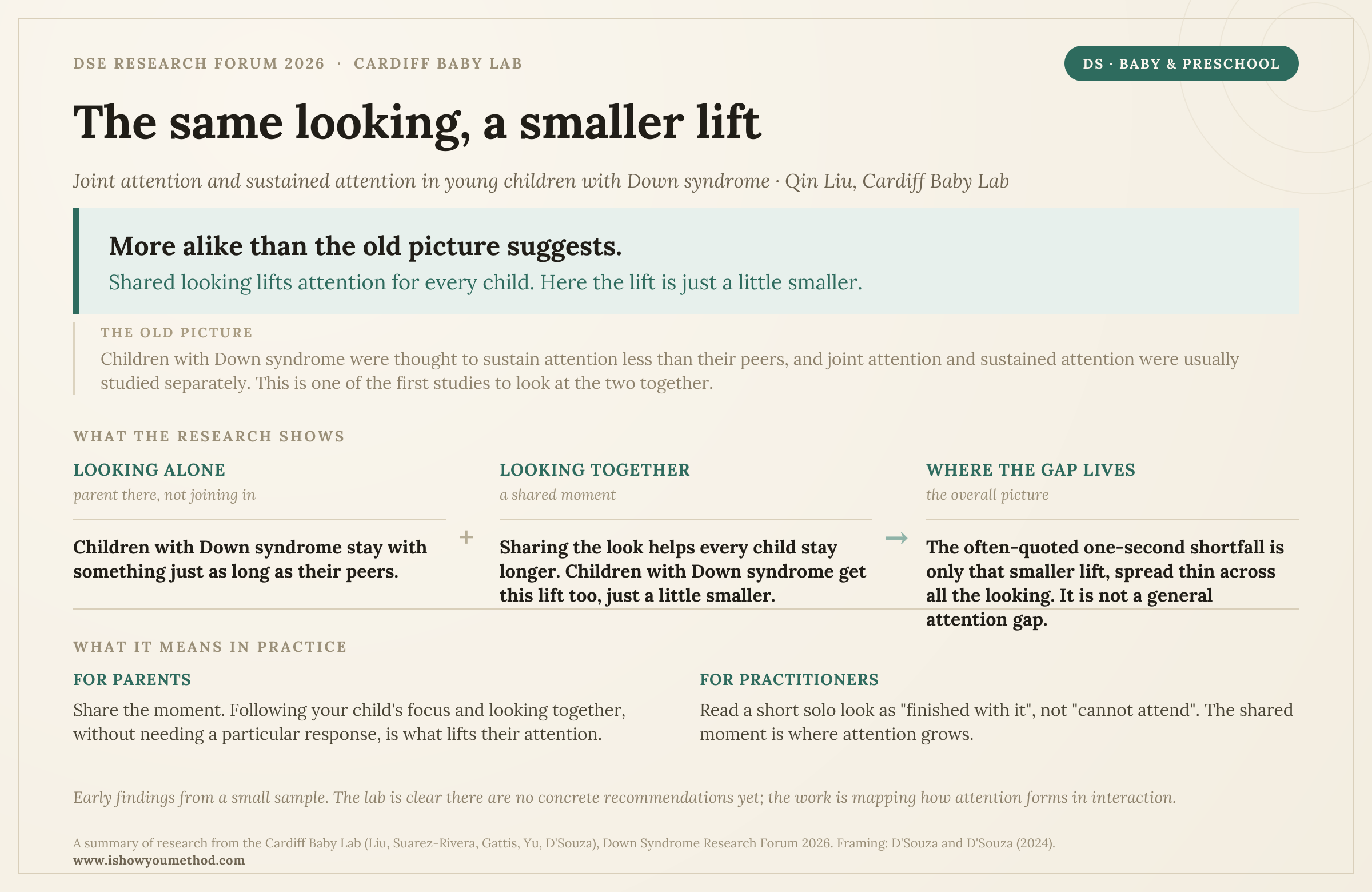
The presentation set the scene with the conventional account. Children with Down syndrome are usually described as having more difficulty with staying with something (sustained attention) than their typically developing peers, while looking at something together with another person (joint attention) tends to look similar to their peers. The two have also tended to be studied apart from one another, one at a time.
Liu's own results, at first, seemed to confirm that view. Looking at sustained attention on its own, collapsed across the whole play session, she found roughly a one second lag in children with Down syndrome compared with their peers, in line with previous studies.
Her study was run in the Cardiff Baby Lab, where researchers fit lightweight head-mounted cameras to both child and caregiver during play. Two cameras, one for the eye and one for the scene, let them see precisely what each person is looking at, moment by moment: faces, objects, the same thing together or different things apart, and for how long. That precision is what allowed the initial "sustained attention is harder for these children" reading to be opened up and examined. The child was playing with their caregiver throughout, so the obvious question was what happened to that staying-with-something when the adult was looking at the same object, and when they were not.
Liu framed it as two conditions:
- Sustained attention with joint attention: how long a child stays with something while their caregiver is attending to the same thing.
- Sustained attention without joint attention: how long a child stays with something while their caregiver is present but attending to something else.
Here is where I got stuck, so let me flag it plainly. In the without-joint-attention condition, the staying power of children with Down syndrome was equivalent to that of their peers. The same. How could that be, when previous work, and Liu's own collapsed figure, pointed to a delay? Her results also confirmed there was no group difference in joint attention itself. So was the earlier finding simply wrong, or was it pointing at something we had been misreading?
This is where the nuance, the role of joint attention, earns its place. The apparent difficulty was not in the child's capacity to sustain. It was in how joint attention interacts with sustained attention. When a child and a caregiver look at the same thing together, the child's staying-with-something is boosted, and that is true for children with Down syndrome and for their peers alike. The single difference Liu found was in the size of that boost: a little smaller for children with Down syndrome, a small but consistent difference. And the one second lag in the collapsed figure turns out to be exactly that smaller boost, spread thin across all the looking. It is not a general attention gap.
Two things keep this honest. The equivalence when the child looked on their own holds for a setting where the caregiver was present but not joining in; there was no condition in which the child was entirely alone, so this is not a claim about attention in a vacuum. And the smaller boost is a smaller observed benefit on this occasion, not a ceiling on what these children can do. Why it is smaller is not yet known.
My confusion, when I sat with it, was instructive. Here is what I had taken to be established, in simple terms:
- Joint attention: the same for children with Down syndrome as for their peers.
- Sustained attention: poorer for children with Down syndrome than their peers.
Liu's collapsed figure seemed to confirm that second line. But the fuller analysis showed something else:
- Joint attention: the same across the two groups.
- Sustained attention: also the same across the two groups.
- Joint attention boosts sustained attention for both groups, a little less so for children with Down syndrome.
What I noticed was my own pull to sort the results into tidy boxes, to find the "relative difficulty", because that is the phenotype framing I am used to in the Down syndrome world. I went looking for a clear-cut deficit and found similarity instead.
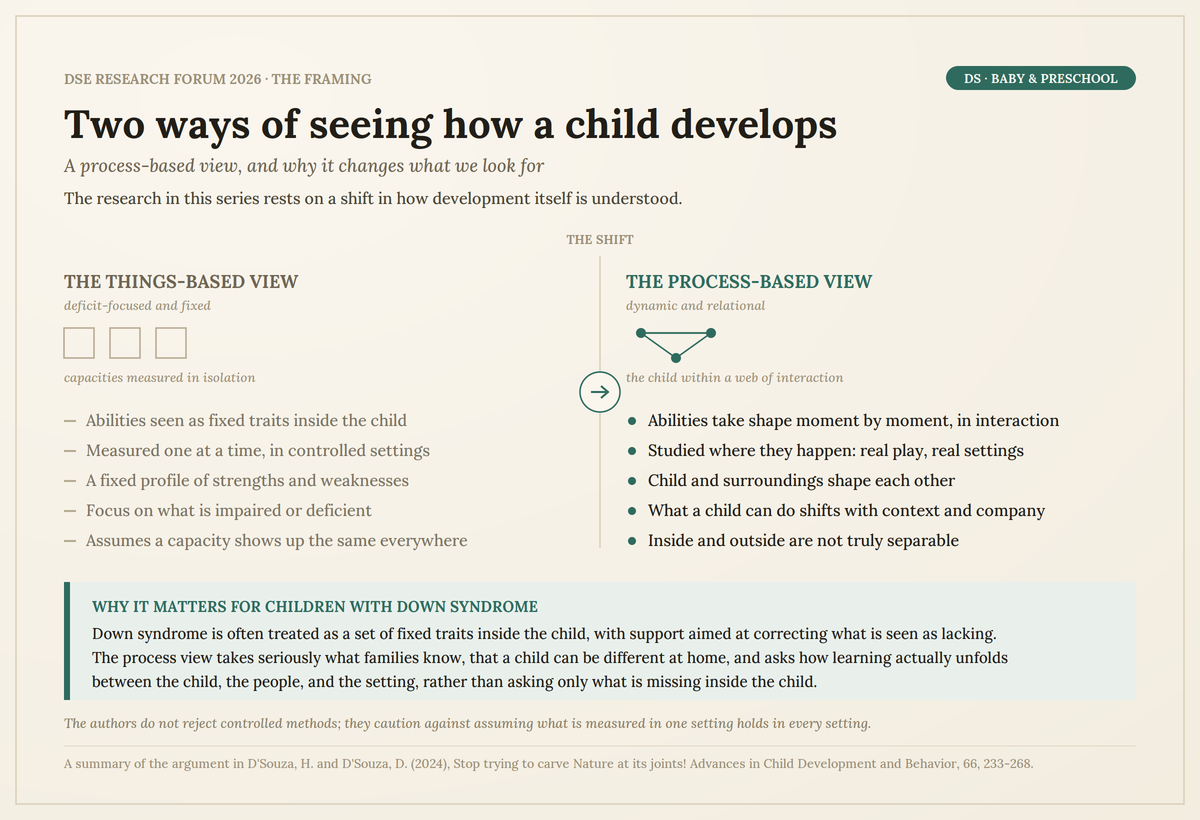
That pull is exactly what D'Souza and D'Souza take apart in their 2024 paper, Stop trying to carve Nature at its joints. The historic scientific instinct is to control the variables to get a clean read on a capability. But if you strip away the child's interaction with their environment, you do not get a purer measure; you get a less accurate one.
It is easy to see how the old "sustained attention is poorer" reading came about. Test a child alone with a dull, repetitive task and no one to share it with, and a short attention span may say more about the task than about the child. Put a child in a busy scene full of competing toys, and a short look may simply mean a more interesting object won. Both can manufacture the appearance of a sustained-attention difficulty that is really a feature of the setting.
To get a true read on sustained attention in children with Down syndrome, you have to watch how they direct it in the social setting of joint attention, which is where so much early attention actually lives. The head-mounted cameras still give a precise read of staying-with-something without the benefit of joint attention, and it is in that benefit, not in any deficit, that the difference sits.
This paves the way for a more nuanced conversation about how capability is expressed in children with Down syndrome. Because what this study failed to show, however hard I looked for it, was a deficit in sustained attention. It showed children who are more alike than different to their peers on both sustained attention and joint attention. The only difference was that the boost joint attention gives to sustained attention was not quite as strong for children with Down syndrome. That is not a deficit. That is an incredibly positive, life-affirming result.
Groundbreaking work. I look forward to seeing this approach move into home-based studies that extend these findings, where the picture may well shift again.
These are early findings from a small sample, and the lab is clear that there are no concrete recommendations to draw from them yet. The work is still mapping how attention forms in interaction.
Seen More Clearly: What Young Children with Down Syndrome Handle During Play, and the Tools Being Built to See It
Down Syndrome Research Forum, Mar 2026 Symposium. Attention and action during play in young children with Down syndrome: Insights from head-mounted eye-tracking and cameras.
Bocchetta and colleagues, 'How motor actions of young children with Down syndrome, and their parents, shape what they see.'
Thompson and colleagues, 'Detecting tiny hands: Evaluating automated hand detection on a unique headcam dataset of young children with and without Down syndrome.'
I have put these two talks together on purpose, because reading them side by side is what made each one land for me. Charlotte Bocchetta's work is about what a young child actually sees and handles during play. Craig Thompson's is about building the tools that let us see it at all. On their own, each is interesting. Together they make a point that sits at the heart of the process-based view: in this kind of science you cannot really separate the finding from the instrument that found it. What we can measure shapes what we are able to notice, and for a long time the instruments have quietly narrowed the picture.
What the child handles
Bocchetta's question is deceptively simple. During ordinary play, what is actually filling a child's view, and how does it get there? To answer it, the lab fits lightweight head-mounted cameras to both child and caregiver, one camera for the eye and one for the scene, so they can reconstruct what was in front of the child moment by moment and where the child was looking within it. The same group took part as across the symposium: fifteen children with Down syndrome and fifteen typically developing children, matched on ability level, playing freely with a small set of objects.
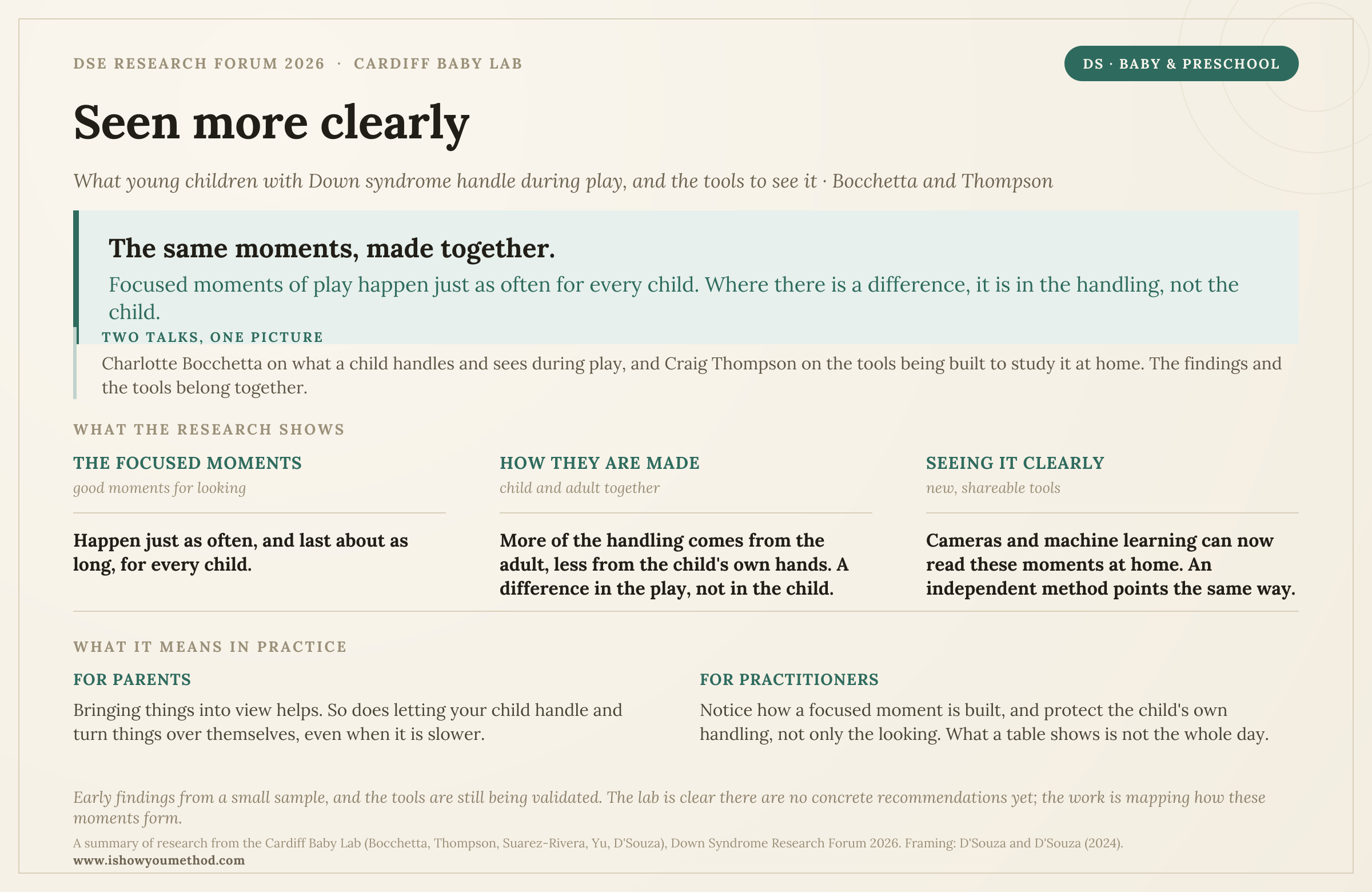
Working with Thompson, Bocchetta used machine learning to measure how large each object was in the child's view, frame by frame, and to pick out what the field calls object dominant events: the moments when a single object fills the scene, stands clearly above everything else, and stays there for at least half a second. Earlier work links these focused moments to stronger attention and learning, so they are, in effect, good moments for looking.
Here is what struck me. On the shape of those moments, the two groups were alike. They happened about as often, arrived at roughly the same rhythm, lasted about as long, and in both groups the child was looking at the dominant object in most of them. The focused, learning-rich moments were equally available to the children with Down syndrome.
The differences were specific and, I think, easy to misread. The dominant objects tended to sit a little larger in the view of the children with Down syndrome. And the handling differed: the children with Down syndrome handled those objects less, while their parents handled them more. The focused moment arrived at the same place, but by a different route, with less of it made by the child's own hands and more of it shaped by the parent's.
It would be easy to read "handles less" as "does less well". I caught myself starting to. But that is the deficit reflex again, the pull to find a shortfall, and it is not what the data says. What the data says is that the visual learning environment these children have during play is, in its key features, equivalent to their peers', and assembled through a different balance of agency between child and adult. Bocchetta is careful about the obvious next question, and so is the lab: when a parent does more of the handling, is that scaffolding the moment so it lands as it should, or is it more hands-on than the child needs? The current data cannot say. That honesty matters, because the answer points in opposite practical directions, and it would be easy to assume the wrong one.
How we come to see it
This is where Thompson's talk stopped being a methods footnote for me and became half the story. If the interesting differences live in the fine grain of handling, moment by moment, then everything depends on being able to capture and read that grain, ideally not only in a lab but in the places children actually live.
Thompson's starting point is that the everyday is hard to study at scale. The lab sends head-mounted cameras into family homes, with parents as the data collectors, and has released an open-source build manual so others can do the same. The harder problem is making sense of the footage. Detectors trained on adults' hands do poorly on the hands of very young children, missing fists and awkward angles, with error in the first year of life that can run as high as a third, far too much for fair comparison. So Thompson retrained a model on the lab's own footage to do three things the standard tools could not: find young children's hands reliably, tell the child's own hand from an adult's, and track objects across frames to measure how often each was picked up, by whom, and for how long. The plan is to package it as an easy-to-install tool, no programming required, as the lab has already done with automated face detection.
Applied to the same thirty children, the early results suggest the overall amount of hand exposure is broadly comparable between the groups, but that children with Down syndrome may see fewer of their own hands and more of other people's. Thompson is clear this is preliminary, with more validation to come and a publication in preparation. What I find quietly remarkable is the direction of it. An entirely separate method, built by a computer scientist to read raw video, points the same way as Bocchetta's frame-by-frame analysis of who is handling what. Two different instruments, one picture: a different distribution of hands, the child's and the adult's, around the same play.
What it adds up to
Put together, the two talks say something I find genuinely hopeful. Where a difference shows up for children with Down syndrome in this work, it is not a thinner or poorer attention, and it is not a smaller visual world. It is a different balance of handling and agency inside the shared business of play, the kind of difference that lives in the interaction rather than inside the child. That is exactly where D'Souza and D'Souza's process-based approach would have us look, and it is the opposite of the old habit of carving the child into separate capacities and reading off a deficit.
It also says something about the work itself. The reason this picture is only now coming into view is that the tools to see it are only now arriving: cameras a family can wear at home, models that can tell one small hand from another, methods built to be shared rather than hoarded. Thompson framed some of this around children's right to have their own perspective represented, including in policy, and I think that is the right frame. These are instruments for seeing a young child's world more nearly as the child meets it, and then building on what is already working in it.
Both talks are early. The lab is explicit that there are no concrete recommendations to draw yet; the work is mapping how these moments form, and the tools are still being validated. But the trajectory is clear, and it is a generous one: less carving, more watching, and a steadily clearer view of the everyday.