Down Syndrome Research Forum, Mar 2026 Symposium: Executive function and practical implications

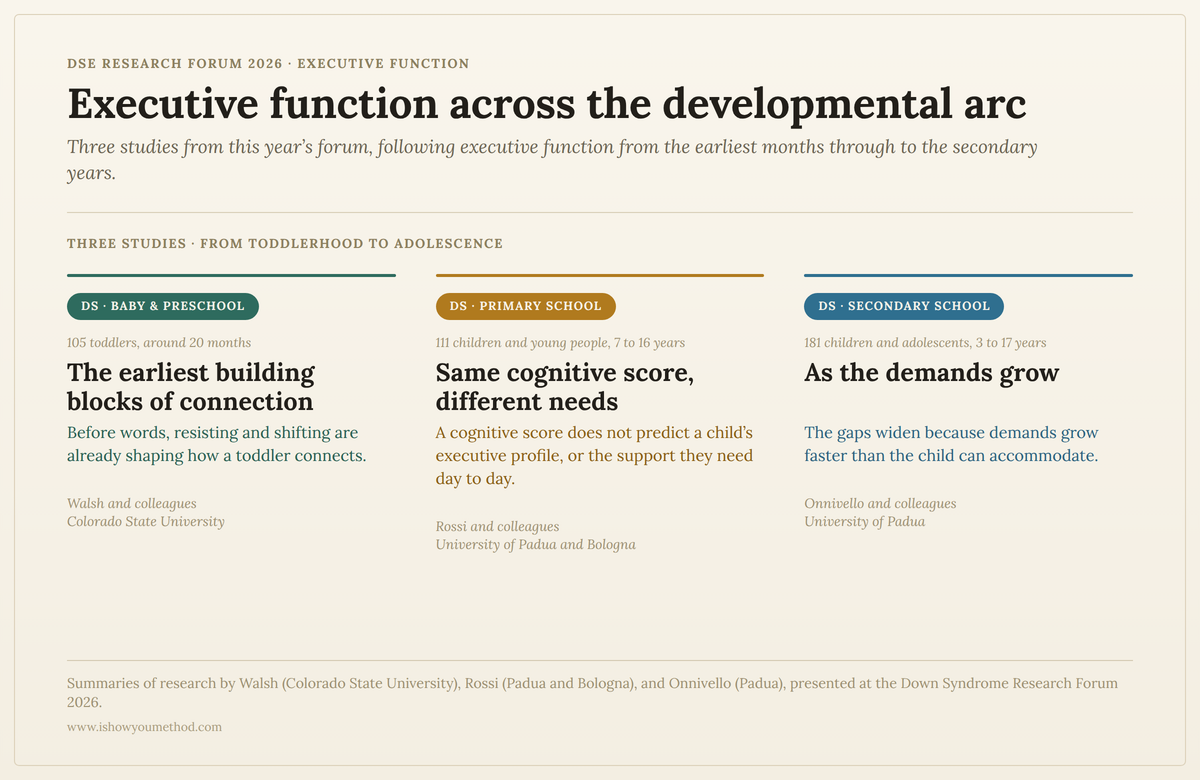
'Resist' and 'Shift': the earliest building blocks of connection in toddlers with Down syndrome
Down Syndrome Research Forum, Mar 2026 Symposium: Executive function and practical implications: Walsh and colleagues: 'Caregiver-reported social foundations and cognitive regulation in toddlers with Down syndrome.'
Most support for a child with Down syndrome begins once a difficulty has already shown itself. A study presented at the Down Syndrome Research Forum 2026 by Madison Walsh, of Colorado State University, made me wonder whether we sometimes arrive a little late. It looks at executive function, the managing of attention and behaviour, not at school age where we usually meet it, but in toddlers who are not yet talking. What it finds there quietly reframes what those early months are for.
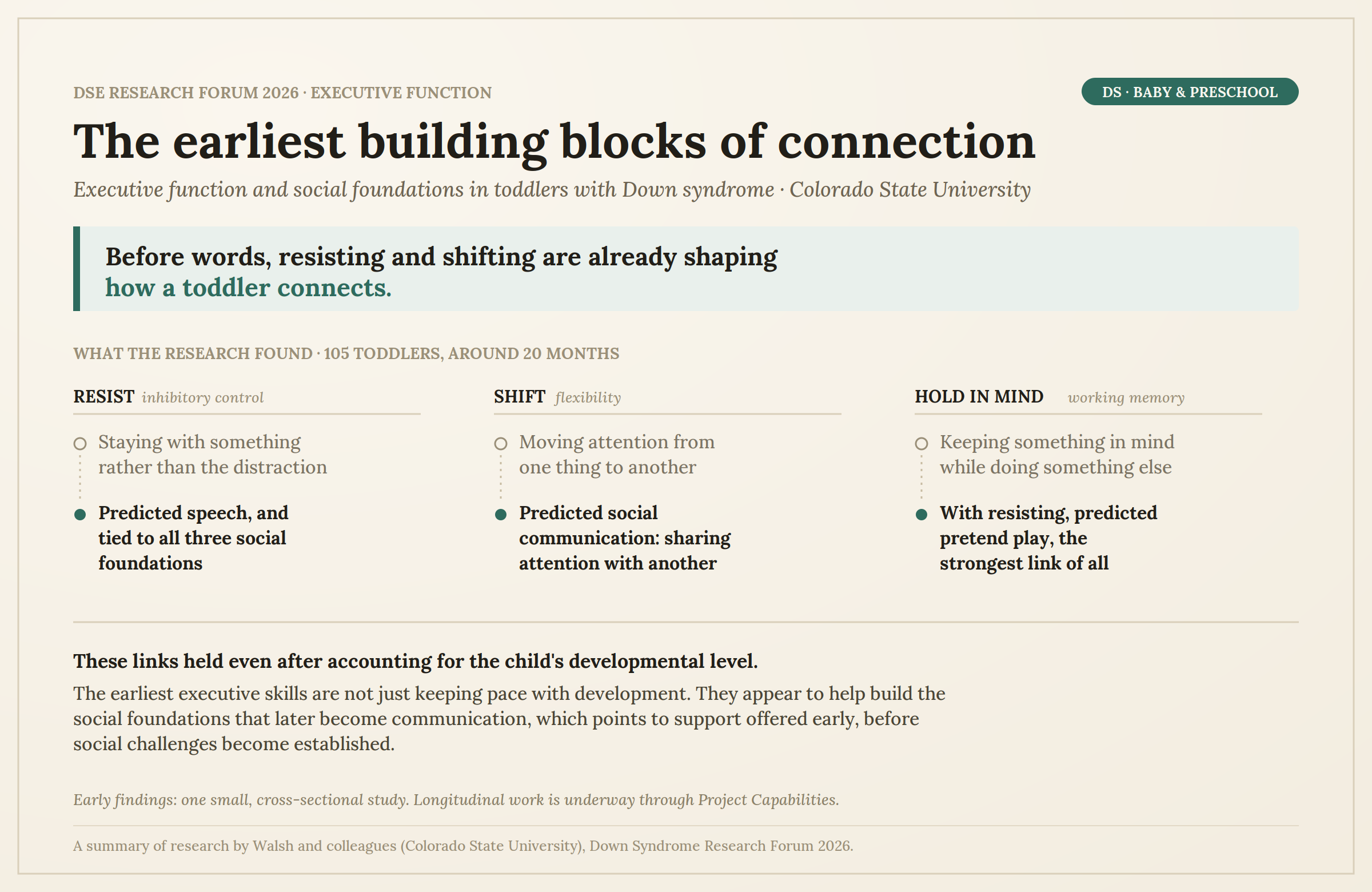
Walsh and her team worked with 105 toddlers with Down syndrome, on average just over 20 months old, with an average developmental age of around 11.5 months. Before words, a child manages attention and behaviour through the body and the gaze, and this is also how they begin to share the world with another person. The study asked a simple question with large implications: do these earliest executive skills predict the social foundations that later become communication?
The executive skills it looked at are the quiet ones. Inhibitory control, the capacity to resist a distraction and stay with something. Flexibility, the capacity to shift attention from one thing to another. Working memory, holding something in mind. And regulation. Against these sat the social foundations: sharing attention through eye gaze, gesture and sound; early speech; and symbolic play, the first pretending, when a block becomes a phone. Even after accounting for each child's developmental level, resisting and shifting were doing real work. Shifting predicted social communication. Resisting predicted speech, and together with working memory it predicted symbolic play, the strongest link of all. Regulation, at this age, did little.
I had expected developmental level, or working memory, to carry the weight. The data pointed somewhere simpler and earlier, to the toddler's ability to hold a focus and to move it. These are not yet social skills. They are the capacities that make social skills possible: staying with a face rather than a distraction, looking from an object to a person and back. Walsh's argument is that if these foundations are where social development takes root, then support offered here, before the social challenges we usually wait for, might change the shape of what comes later.
It is one study, small, measuring a single moment rather than following children over time, and it rests on what caregivers report, which is rich but inevitably subjective. Walsh is careful about this. The longer view is already being built: these children are part of a multi-site project, Project Capabilities, gathering data as they grow. So this is a beginning, not a conclusion.
What stays with me is where the important moment turns out to sit. The developmental story of a child with Down syndrome is already being written at around 18 to 20 months, in the ordinary texture of play, attention, and shared looking. That is not a small thing to know. It is where the building starts.
A one-page summary of the findings, and a downloadable easy guide for putting this into everyday practice, accompany this post.
Citation: Walsh, M., Pinks, M., Van Deusen, K., Prince, M., Bishop, S., Baumer, N., and Fidler, D. (2026). "Caregiver-reported social foundations and cognitive regulation in toddlers with Down syndrome." [Conference presentation]. Down Syndrome Research Forum 2026. Colorado State University.
Same cognitive score, different needs: what executive function profiles reveal at school age in Down Syndrome
Down Syndrome Research Forum, Mar 2026 Symposium: Executive function and practical implications: Rossi and colleagues: 'Executive function profiles, adaptive behavior and cognitive abilities in youth with Down syndrome: implications for individualized intervention.'
In toddlers, Madison Walsh found the earliest executive foundations, resisting and shifting, already shaping how a child connects. By school age the picture is no longer a single story. Elisa Rossi and colleagues at the University of Padua and the University of Bologna looked within the population of school-age children with Down syndrome and found something that should change how we plan support: three distinct executive function profiles, and a child's cognitive score tells you almost nothing about which one a child is in.
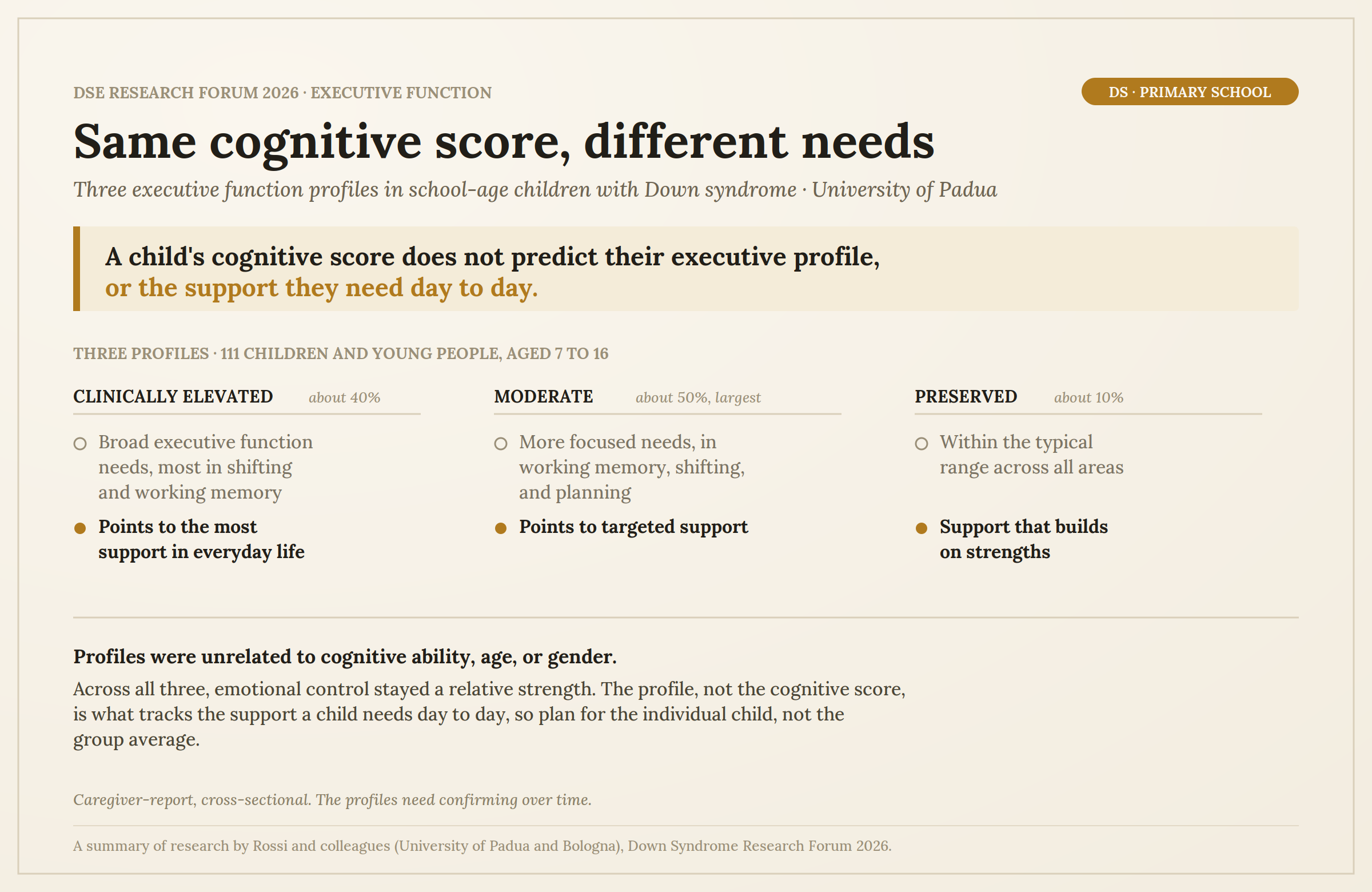
Rossi worked with 111 children and young people with Down syndrome aged 7 to 16. Executive function was rated by caregivers across five areas, inhibition, shifting, emotional control, working memory, and planning and organising. Cognitive ability was measured separately, as were adaptive behaviour, the everyday skills of daily life. Rather than averaging across the group, which is how most of this research has been done, Rossi used a person-centred method to ask whether distinct subgroups exist. Three did.
The largest group, around half the children, showed more focused executive needs, mostly sub-clinical, concentrated in working memory, shifting, and planning. A second group, around 40 percent, showed the broadest executive function needs, across most areas and most pronounced in shifting and working memory. A third, smaller group, around 10 percent, scored within the typical range across every area. What ran through all three was emotional control, which remained the least affected area regardless of the rest of the profile, a relative strength that held wherever a child sat. The profiles differed most in shifting and in planning and organising.
Then comes the finding that matters most for anyone planning a child's education. Which profile a child belonged to was not related to their cognitive ability, nor to their age or gender. It was strongly related to their adaptive behaviour: the children whose profiles showed the broadest executive needs were also those who needed the most support in everyday life. Two children with the same cognitive score can sit in entirely different profiles, with entirely different everyday needs. A cognitive assessment and an executive profile are different instruments answering different questions, and one cannot stand in for the other.
There is a thread worth naming here. The shifting that Walsh identified as an early foundation in toddlers is, by school age, one of the two areas of greatest executive need in the elevated and moderate profiles, which together account for around 90 percent of these children. The early stepping stone is, for many, an area that now needs support. And emotional control, quietly, holds.
The preserved profile, small as it is, matters not because it sets a target for the other 90 percent, but because it shows the relationship between Down syndrome and executive function is not fixed or uniform. Individual variability is real. The useful unit of planning is the child in front of you, with their own profile and their own everyday picture, rather than the group average a diagnosis might invite.
A one-page summary of the three profiles, and a downloadable easy guide for assessment and classroom planning, accompany this post.
As the demands grow: executive function and behaviour through the school years in Down syndrome
Down Syndrome Research Forum, Mar 2026 Symposium: Executive function and practical implications: Onnivello and colleagues: 'Executive functions and behavioral difficulties in children and adolescents with Down Syndrome.'
Madison Walsh showed the early foundations. Elisa Rossi showed that by school age children with Down syndrome fall into distinct executive profiles. Sara Onnivello and colleagues at the University of Padua asked a further question: how does executive function connect to everyday behaviour, and how does that connection change as children move from the preschool years toward adolescence, when the demands of daily life are at their most complex?
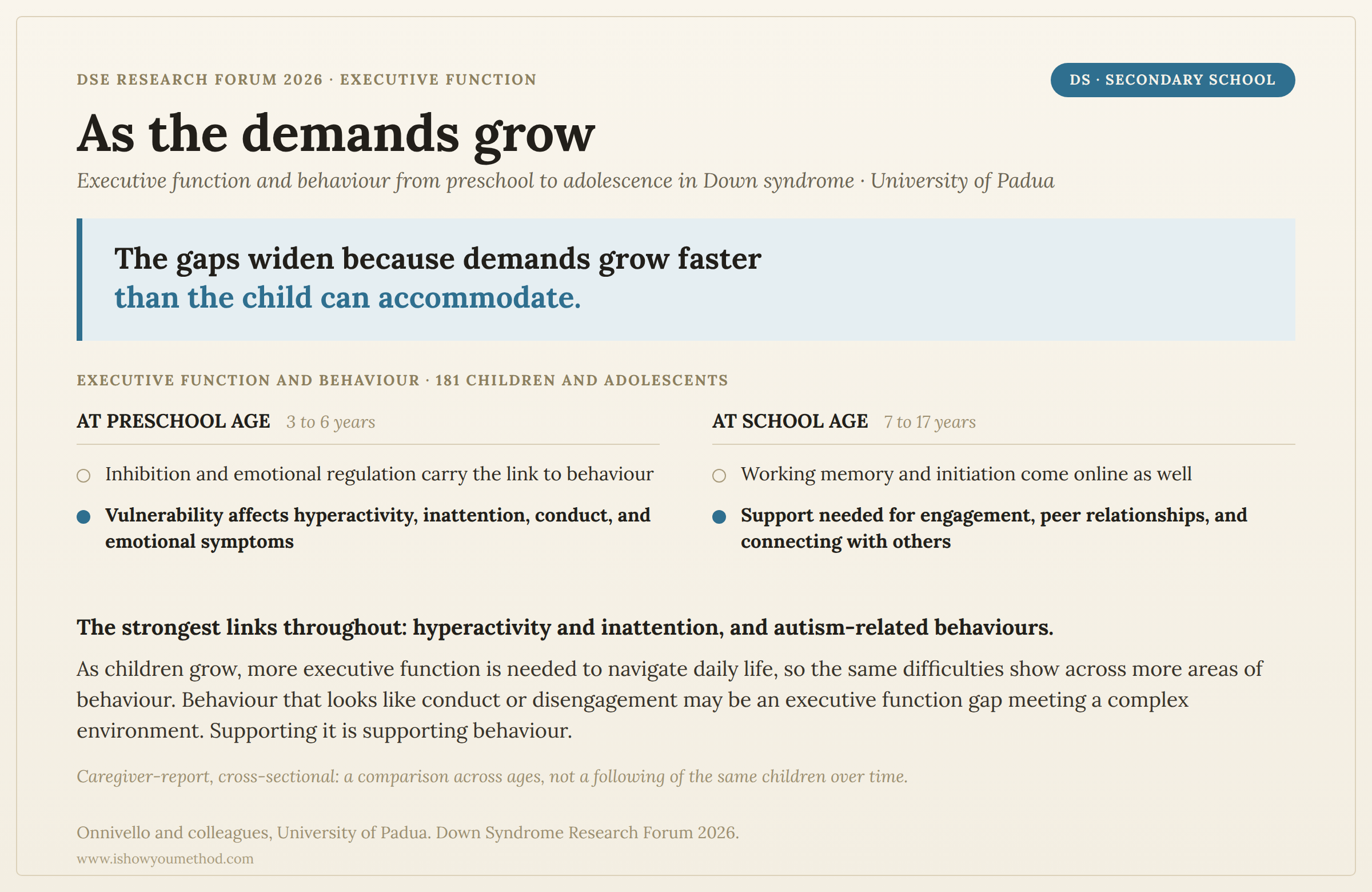
Onnivello studied 181 children and adolescents with Down syndrome, a preschool group of 68 aged 3 to 6 and a school-age group of 113 aged 7 to 17. Executive function and behaviour were both rated by caregivers, behaviour across five everyday areas from emotional wellbeing to friendships, alongside a measure of autism-related behaviours. The design is cross-sectional, a comparison across ages rather than a following of the same children over time.
Executive function and everyday life were linked at both ages, but the links were stronger and more numerous in the older group. At preschool age, inhibition and emotional regulation carried most of the connection, showing in a child's focus and energy, in managing impulses, and in worries and feelings. At school age the picture widened. Inhibition and emotional regulation still mattered, and working memory and initiation came online too, showing in holding routines, in connecting with peers, and in finding a way to start something. Throughout, the clearest signals were around focus and energy, and around social communication.
What I find clarifying about Onnivello's reading is the direction of the explanation. The widening reflects a rise in what daily life demands, not a change in the young person. As children grow, more executive function is required to navigate ordinary daily life, so the same underlying executive function needs begin to show across more areas of behaviour. By the secondary years the demands are at their widest, which is exactly why working memory and initiation, quieter in the preschool picture, now carry the most reach.
That reframe has a practical edge. Behaviour that reads as conduct difficulty or disengagement may be executive function meeting a more demanding environment, a sign of an unmet need rather than a problem located in the young person. On this evidence, supporting executive function is a way of supporting behaviour, participation, and wellbeing together, and it is a target available now, not a future aspiration.
The study measures one point in time and relies on caregiver report, so it sketches a developmental direction rather than proving one. Onnivello is clear about this, calling for longitudinal data, for combining caregiver report with direct measures, and for looking at the environmental factors that may shape these associations. Held lightly, though, the message is steadying: the widening we see with age is not a verdict on the young person. They are a signal about the demands we are placing around them, and about where support can do the most good.
A one-page summary, and a downloadable easy guide for secondary practice and home, accompany this post.