Character Strengths are associated with achievement

Why a strengths approach is also a learning strategy, not only a wellbeing one
Why this matters
A strengths-based approach is usually offered to schools as a way to support wellbeing. That is real, but it understates the case. The published research also connects character strengths to academic achievement, which means a strengths approach has a place in the conversation about progress, not only in the conversation about pastoral care.
What the research found
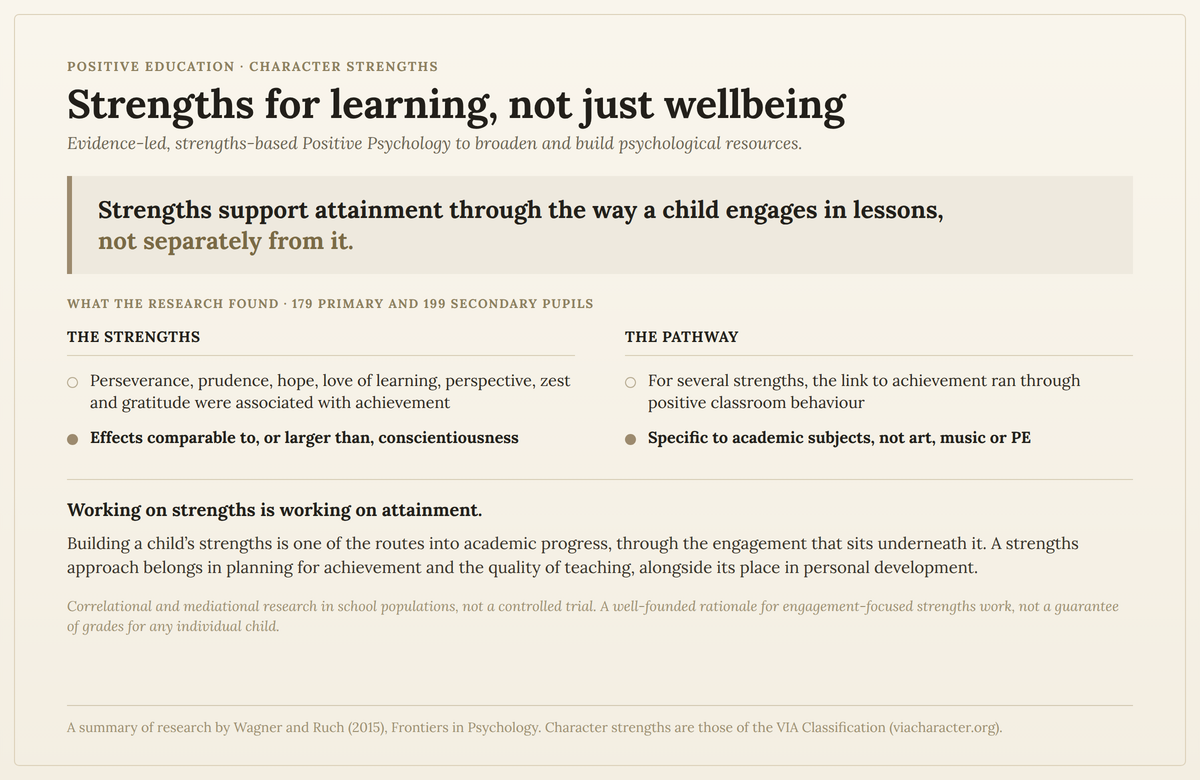
The clearest school-based evidence comes from a study by Wagner and Ruch, who looked at character strengths and school achievement across two age groups (a primary-age sample of 179 pupils and a secondary-age sample of 199). Several strengths, including perseverance, prudence, hope, love of learning, perspective, zest and gratitude, were associated with achievement at school.
The more useful finding is how that association works. For strengths such as perseverance, prudence, hope, self-regulation and social intelligence, the link to achievement ran through positive behaviour in the classroom. In plain terms, these strengths help a child engage, persist and conduct themselves well in lessons, and it is that engagement which supports their attainment. The researchers noted that the size of these effects was comparable to, or larger than, the effects usually reported for conscientiousness, a trait long associated with academic success.
One detail keeps the picture honest and is worth holding onto. The strengths were linked to achievement in academic subjects, not to grades in non-academic subjects such as art, music and physical education. So the effect is specifically about engagement with academic learning, not about being generally well-liked. That precision is a feature, because it tells a school where the benefit operates.
What it means in practice
Building a child's character strengths is not separate from their academic progress. It is one of the routes into it, through the way the child engages with classroom learning. A school that works on strengths is therefore working on attainment, by improving the engagement that sits underneath it. This is why a strengths approach belongs in planning for achievement and for the quality of teaching, alongside its more familiar place in personal development and wellbeing.
About the evidence
This is correlational and mediational research in school populations. It establishes the link between strengths and achievement and identifies classroom engagement as the pathway. It is not a controlled trial showing that a particular strengths programme raises grades. Used as a rationale for engagement-focused strengths work, it is well founded. It should not be presented as a guarantee of improved results for any individual child.
Here's a downloadable easy guide to get started:
Source
Character strengths throughout are those of the VIA Classification, maintained by the VIA Institute on Character (viacharacter.org), where the free VIA Survey and VIA Youth Survey are available.