Character Strengths and Special Educational Needs

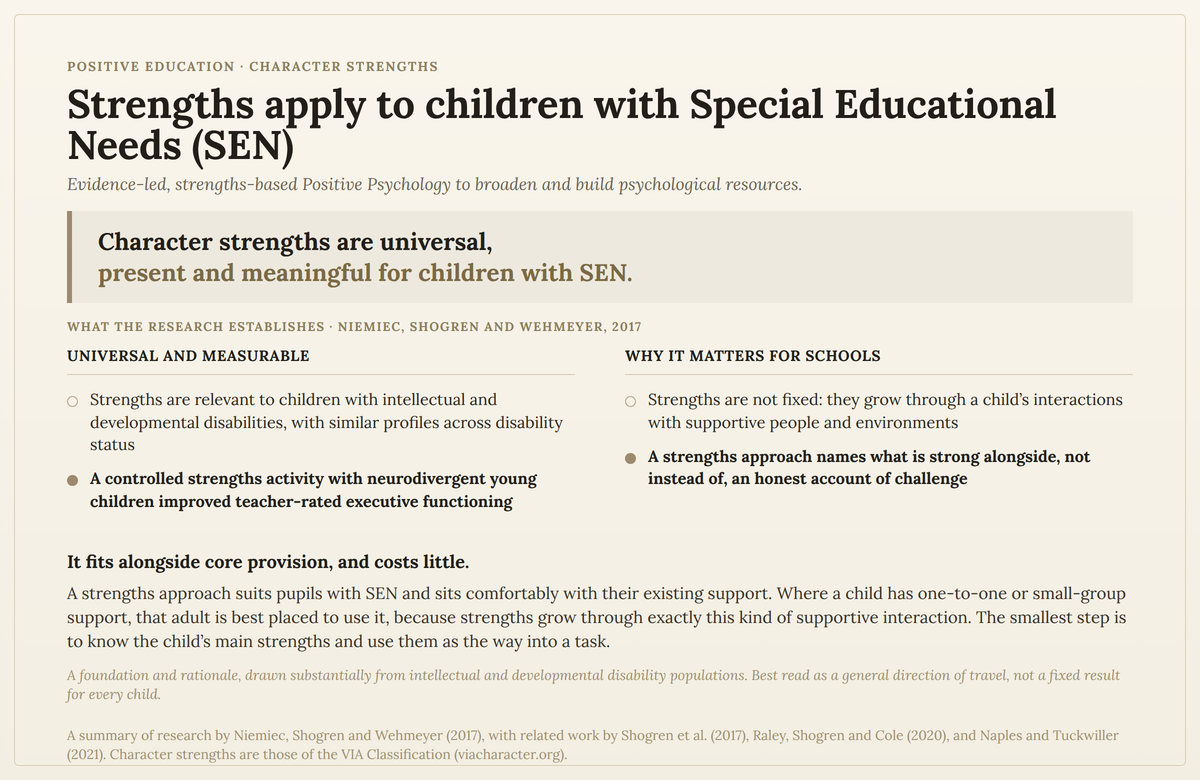
Why a strengths approach applies to children with SEN, and how it fits existing support
Why this matters
A fair question for any school is whether a strengths approach applies to pupils with special educational needs, or only to typically developing children. The published research answers it directly: character strengths are present and meaningful in children with learning disabilities and developmental differences, and the approach is well suited to them.
What the research establishes
The foundational statement comes from Niemiec, Shogren and Wehmeyer, who set out the case that character strengths are universal and relevant to people with intellectual and developmental disabilities. Related work using the VIA Youth Survey found that the assessment was reliable and meaningful for young people both with and without disabilities, and that similar strengths profiles emerged across both groups. The same body of work reports that strengths-based approaches in education are low in cost, and a controlled study of a strengths activity with neurodivergent young children found benefits in teacher-rated executive functioning.
Two points carry the most weight for a school. First, strengths can be cultivated through a child's interactions with the people and environments around them. They are not fixed traits a child either has or lacks, which means a supportive adult can help them grow. Second, a strengths approach names what is genuinely strong in a child alongside, not instead of, an honest account of where they are challenged. It widens the picture rather than ignoring difficulty.
What it means in practice
A strengths approach is appropriate for pupils with SEN, sits comfortably alongside their core provision, and costs little to add. It is one more way of planning around what a child can do. Where a pupil already receives one-to-one or small-group support, the adult who provides it is particularly well placed to use the approach, because they are the child's most consistent point of contact and the research is explicit that strengths grow through exactly this kind of supportive interaction. The smallest effective step is for that adult to know the child's main strengths and use them as the way into a task.
About the evidence
This literature establishes that character strengths are present and meaningful in this population, and that the assessment works for these children. It is a foundation and a rationale, drawn substantially from intellectual and developmental disability populations. Children's needs vary widely, so the findings are best read as a general direction of travel rather than a fixed result that will look identical for every child.
Here's a downloadable easy guide to get started:
Sources
Related:
Shogren, K. A., Wehmeyer, M. L., Lang, K., Niemiec, R. M., & Seo, H. (2017). The application of the VIA Classification of Strengths to youth with and without disabilities. Inclusion, 5(3), 213-228.
Character strengths throughout are those of the VIA Classification, maintained by the VIA Institute on Character (viacharacter.org), where the free VIA Survey and VIA Youth Survey are available.