Activating Character Strengths in the Classroom using VIA

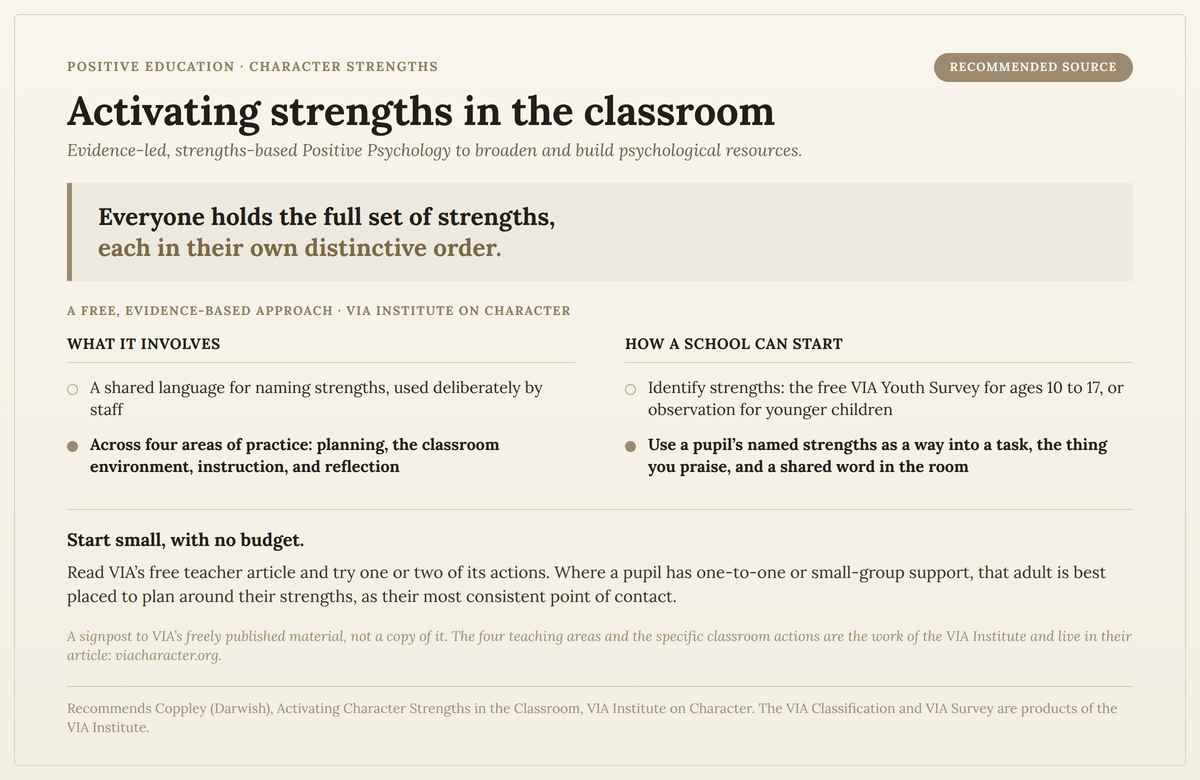
A free, evidence-based approach for schools, and where to find it
The Positive Psychology Character Strengths leader
A character-strengths approach gives a school a simple, low-cost way to shift everyday classroom practice from planning around a child's difficulties towards planning around what each child does well. It is not a programme to buy or a scheme to install. It is a change in how staff notice, talk to, and set work for pupils, and it can begin with no budget and very little preparation.
The VIA Institute on Character is the recommended starting point. VIA maintains the most widely used research-based classification of character strengths, and it publishes a free, practical article for teachers on putting a strengths approach to work in the classroom.
What the approach involves, at a high level
The core idea is straightforward. Every person holds the full set of recognised character strengths, and at the same time each individual has their own distinctive ordering of them. A strengths-based classroom works with that fact. Staff learn a shared language for naming strengths, then use it deliberately: when they plan work, when they give feedback, when they set up the room and its routines, and when they reflect on their own practice.
VIA's teacher article organises this around four familiar areas of teaching practice, covering how strengths can inform planning, the classroom environment, instruction itself, and a teacher's own professional reflection. For each area it offers small, immediate actions a teacher can try without any special training. We are not reproducing those actions here on purpose: the live article is the right place to read them, in the author's own words and kept up to date by VIA.
Why it fits a school now
Three things make this approach a good fit for current school priorities.
It supports wellbeing. A shared language of strengths gives pupils an accurate, positive account of who they are, and gives staff a consistent way to recognise rather than only correct.
It supports engagement and learning. Published school research links character strengths to academic achievement through the way they improve a pupil's engagement and conduct in lessons, so this is a learning strategy, not only a pastoral one.
It is inclusive and individualised. The approach plans around what each child can do, which suits a mixed classroom and sits comfortably alongside the support a child with additional needs already receives.
How a school can start
1. Identify strengths. Pupils aged 10 to 17 can complete the free VIA Youth Survey. For younger children, staff can describe the same strengths through observation rather than a questionnaire.
2. Read VIA's free teacher article (linked below) and choose one or two of its small actions to try.
3. Use a pupil's named strengths in ordinary moments: as a way into a task, as the specific thing you praise, and as a shared word in the room.
4. Where a pupil has one-to-one or small-group support, the adult who provides it is the best placed to plan tasks around that pupil's strengths, because they are the pupil's most consistent point of contact.
Here's a downloadable easy guide to get started:
Read the source
The free VIA teacher article is the authoritative version of the classroom approach summarised above. Read it in full here:
Source article: Coppley (Darwish), J., Activating Character Strengths in the Classroom, VIA Institute on Character (Mayerson Academy).
The free VIA Survey and VIA Youth Survey are available at viacharacter.org.
About this document. This is an original summary and recommendation prepared as a signpost to the VIA Institute's freely published material. It is not a copy or reproduction of the VIA article. The classroom approach, the four teaching areas, and the practical actions described by VIA are the work of the VIA Institute on Character and its author, and remain their copyright. For the full article and the actual classroom actions, please follow the link above to VIA's website. The VIA Classification of Character Strengths and the VIA Survey are products of the VIA Institute on Character.